Download
1 / 13
130 likes | 237 Vues
This introduction to ecology explores foundational concepts such as paradigms and paradigm shifts, particularly in relation to human understanding of our connection to nature. It highlights the distinction between renewable and non-renewable resources, emphasizing the importance of sustainable practices for future generations. Key ecological concepts such as the biosphere, biodiversity, habitats, and ecosystems are defined, providing a comprehensive overview of the interactions between organisms and their environment. This knowledge is crucial for addressing environmental challenges and promoting sustainability.

E N D
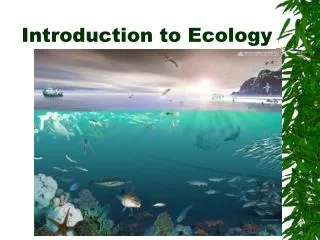
Introduction to Ecology Science 10 Mrs. Purba
Paradigm • Pronounced, “PAIR-A-DIME” • The way we use concepts to build our understanding. • We usually use ideas that are “common” to us, to explain extraordinary things.
Paradigm Shift • Occurs when old paradigms are replaced by new paradigms. • When “old” ways of thinking are replaced by “new” ways of thinking.
Ecological Paradigm Shifts • We believed that as humans, we were totally unrelated to other animal life on Earth • We believed that we were placed on this Earth to “rule” and use the “boundless” resources… • SUPERIORITY COMPLEX
Two Types of Resources • Renewable Resources • Non-renewable Resources
Renewable Resources • Resources that can be replaced as fast or faster than they are being used. Example: Energy from the sun (solar power)
Non-renewable Resources • Resources that cannot be replaced or are being used much faster than they are forming. Example: Coal, oil, natural gas (fossil fuel)
Sustainability • The ability to meet the needs of the present generation without compromising the ability of future generations to meet their needs.
Closed System • An environment where substances do not enter or leave.
Biosphere • The “life zone” of Earth, including the lower part of the atmosphere, hydrosphere, and upper part of the Earth’s crust (lithosphere)
Biodiversity • Variety of living organisms that inhabit Earth Habitat • Place where an organism “lives”. • We can have terrestrial (land) habitats and aquatic (water) habitats.
Ecology • The scientific study of the interaction of organism and their environment. Ecosystem • A community of organisms and the physical environment where they live.