Understanding Earth’s Atmosphere and Climate Zones
Explore the fascinating dynamics of Earth’s atmosphere, including its structure, the layers that compose it, and how they influence weather patterns. Did you know house flies live only 2 weeks, or that the Atlantic Giant Squid has an eye as large as 15.75 inches? Learn about differential heating and the distinct characteristics of polar, temperate, and tropical zones. Additionally, delve into air composition, trace gases, and the role of volcanoes in shaping our early atmosphere. Join us in understanding how altitude affects air pressure and temperature.

Understanding Earth’s Atmosphere and Climate Zones
E N D
Presentation Transcript
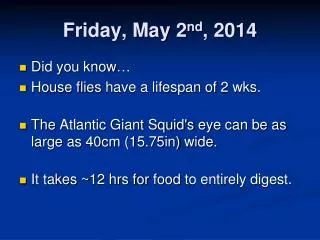
Friday, May 2nd, 2014 • Did you know… • House flies have a lifespan of 2 wks. • The Atlantic Giant Squid's eye can be as large as 40cm (15.75in) wide. • It takes ~12 hrs for food to entirely digest.
Do Now: May 2nd • What is differential heating? • What are the differences btwn polar, temperate, & tropical zones? • How can cities at the same latitude have different weather patterns?
YouTube Friday • http://www.youtube.com/watch?v=cU-eAzNp5Hw • http://www.youtube.com/watch?v=OQm3FjLo-mk
Early Atmosphere • Produced by erupting volcanoes • Mostly Nitrogen, little Oxygen • O2 appeared as orgs photosynthesized (made food from sunlight)
Air Composition • 78% Nitrogen (N2) • 21% Oxygen (O2) • >1% Argon (Ar) Trace Gases Dust, bacteria, & particulates
Trace Gases • ppmv: parts per million by volume • Carbon dioxide (CO2) = 340 ppmv • Neon (Ne) = 18 ppmv • Helium (He) = 5 ppmv • Methane (CH4) = 2 ppmv • Hydrogen (H2) = 0.5 ppmv
Red Tint of Sunrise/Sunset • http://formontana.net/sun.html
Atmosphere has 5 layers • Air pressure & temp change w/ altitude
Troposphere • Lowest/closest atmospheric level • 0 - 16km (~10mi) • Weather takes place • Temp drops as height incr • Most air pollution
Stratosphere • 2nd closest atmospheric layer • 16 - 50km (31mi) • Concentrated, protective ozone • Temp incr as height incr • Jets fly here • Jet stream: rivers of air in base of layer
Mesosphere • Middle atmospheric layer • 50 - 90km (56mi) • Coldest layer of atmosphere • Temp decr as height incr • Meteors burn up here
Thermosphere • 4th atmospheric layer • 90 - 300km (186mi) • Temp incr as height incr • Hottest layer • Lonosphere: makes auroras (curtains of light)
Exosphere • Outermost/farthest atmospheric layer • Temp incr w/ height incr • Composed mostly of hydrogen & helium • Satellites orbit earth • No clear boundary btwn atmosphere & space
Pressure & Density • Gravity pulls gases toward surface • Air pressure: force exerted over an area of surface • Air Density: # of air molecules in a given space/volume
Atmospheric Layers • Air pressure & density decr w/ elevation • Temp has complex vertical profile • Lapse Rate: temp decr due to sunlight warming earth’s surface, then surface warms air above it • ~3.6°F per 1000ft rise • Temp inversion: air temp incr w/ height
Remembering the Layers… • The • Science • Monkey • Took • Earth • Troposphere • Stratosphere • Mesosphere • Thermosphere • Exosphere