Download
1 / 7
80 likes | 218 Vues
This guide explores the concept of higher derivatives, starting from the first derivative ( f' ) to higher order derivatives ( f'', f''', ) and beyond. It discusses how each derivative represents a rate of change, with the second derivative indicating the rate of change of the first derivative (acceleration). Using an example function, we find the higher derivatives and illustrate their importance in understanding motion, especially how velocity changes over time (acceleration). Visual presentations of position, velocity, and acceleration functions are also included for clarity.

E N D
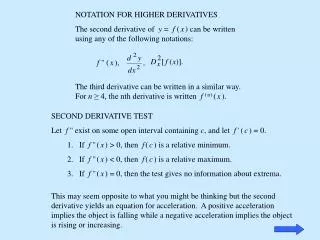
If f is differentiable to f’, then f’ may have its own derivative, f’’, called the second derivative • This is the rate of change in f’ – how fast f’ is changing
Example If , find f’’
More Derivative of f’’ is f’’’ – Third Derivative Derivative of f’’’ is f’’’’ – Fourth Derivative Etc.
Example Find y’’’’ or y(4)of
Example Find D(27)of y = cos x
Acceleration • Velocity is how fast distance is changing (f’) • Acceleration is how fast velocity is changing (f’’) • A particle’s position is given by the function , find its acceleration at 4.0 sec. Graph the position, velocity, and acceleration functions and explain.