Download
1 / 18
200 likes | 344 Vues
This project investigates the C4.5 decision tree algorithm and the K-Means clustering algorithm using the Iris dataset, which contains 150 items across three classes (Setosa, Versicolor, and Virginica). The study includes an overview of both algorithms, a detailed description of the dataset, and the experimental procedure followed. Results are compared to hypotheticals, analyzing the accuracy and precision of classifications made by both algorithms. The findings demonstrate the effectiveness of C4.5 and K-Means in data partitioning and classification, with a focus on their advantages and methods of improvement.

E N D
C4.5 and the K-Means Clustering Algorithms By: Clint Tomer MATH 4200 Final Project
Outline • Overview • Introduction to the C4.5 Algorithm • Introduction to the K-Means Clustering Algorithm • Dataset Overview • Description of the Experiment
Outline cont. • Graph of Experiment • Hypothesized Results of Experiment • Actual Results of the Experiment • Experiment Conclusion • Summary
Overview • Use of the C4.5 and K-Means Algorithms • Partitioning the Iris.xls dataset • Run training set through K-Means and C4.5 • Run test set through rules • Compare results
Introduction to the C4.5 Algorithm • An upgrade • Basic idea is to ask questions • Choose splitting attributes
Introduction to the C4.5 Algorithm cont. • Entropy • Entropy is defined as: The given probabilities p1,p2,…..,ps where pi = 1 and H (p1,p2,….,ps) = ( pi log (1/pi))
Introduction to the C4.5 Algorithm cont. • C4.5 improves ID3 in the following ways: • Missing Data • Continuous Data • Pruning • Subtree Replacement • Subtree Raising
Introduction to the C4.5 Algorithm cont. • C4.5 improves ID3 in the following ways cont. • Rules • Splitting • GainRatio (D,S) =
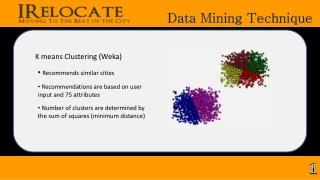
Introduction to the K-Means Clustering Algorithm • Cluster objects • Determine the K-Means • Objects attributes form a vector space
Introduction to the K-Means Clustering Algorithm cont. • The objective K-Means tries to achieve is to minimize total intra-cluster variance, or the function …. where there are k clusters Si, i=1,2,….,k and mi is the mean of all points Xj E Si.
Introduction to the K-Means Clustering Algorithm cont. • The K-Means Clustering Algorithm can be broken down into the following steps • Place k points into the space represented by the objects that are being clustered. • Assign each object to the group that has the closest mean. • When all objects have been assigned, recalculate the positions of the k means. • Repeat steps 2 and 3 until the means no longer move.
Dataset Overview • Iris.xls dataset • 3 Classes • Setosa • Versicolor • Virginica • 4 Attributes • Sepal Length • Sepal Width • Pedal Length • Pedal Width • 150 Items • 50 of each class
Description of Experiment • K-Means • C4.5 • C4.5 Rules • K-Means • Compare • Classification
Graph of the Experiment Ts Td K-Means Classes C4.5 Rules Ts Results Td Results Ts Iris K-Means Classes Compare
Hypothesized Results • Very accurate • Precise
Results of the Experiment • Setosa • Versicolor • Virginica • Classification of data
Experiment Conclusion • C4.5 • K-Means • Classification
Summary • C4.5 Algorithm • K-Means Clustering Algorithm • Dataset • Experiment