Understanding PCR: The Science Behind DNA Amplification and Its Applications
Polymerase Chain Reaction (PCR) is a revolutionary technique that amplifies billions of copies of a specific DNA sequence from minimal starting material, like blood or skin cells. By isolating pure quantities of DNA, PCR is invaluable in criminal investigations for suspect identification and in sequencing the human genome. The procedure involves key components such as target DNA, primers, and Taq polymerase, cycling through temperature changes to denature, anneal, and extend DNA strands. This process allows for the study and analysis of DNA with precision and efficiency.


Understanding PCR: The Science Behind DNA Amplification and Its Applications
E N D
Presentation Transcript
PCR Polymerase Chain Reaction (PCR)
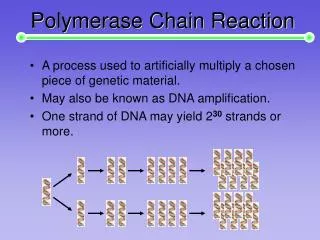
PCR • PCR produces billions of copies of a specific piece of DNA from trace amounts of starting material. (i.e. blood, skin cells, bone) • Allows scientists to isolate pure quantities of specific DNA sequences • 230 = over 1 billion copies of a specific DNA fragment; large enough quantity to be analyzed • Used in: • Criminal Investigations to identify suspects • Sequencing the Human genome
What DNA is Used? • 46 Chromosomes code for 30,000 to 50,000 genes; only 5% of your DNA • Exons = DNA that is coded or expressed into proteins • Noncoding DNA has more diversity; since this DNA rarely leaves the DNA to head to ribosomes • Introns = DNA that is rarely expressed • Increased number of mutations
What ingredients are needed? • Target DNA – the DNA that needs to be copied • Primers – short pieces of DNA that are designed to attach to each end of the DNA fragment that will be replicated • Taq polymerase – enzyme that reads the DNA • Comes from the bacteria Thermus aquaticus • Lives in the hot springs in Yellowstone; doesn’t fall apart in high temperatures • dNTPs – 4 nucleotides with the 4 different bases that are needed to replicate DNA • Buffer – gives the best environment for the enzymes to work • Mg Ions – needed by DNA polymerase to make DNA copies
How Does PCR Work? • PCR machine is known as thermal cylcer • Machine changes to three different temperature changes during one cycle • Average number of cycles per run is 30 to 40 What happens at each temperature change?
Temperature at 94ºC • Denaturing temperature • The target DNA falls apart • The H bonds holding the nitrogen bases together break • 2 individual strands of DNA are now present instead of a double helix.
Temperature at 65ºC • Annealing Temperature • Primers attach to the ends of the Target DNA that needs to be copied • Annealing = attachment of the primers • Attach to complimentary bases of target DNA
Temperature at 72ºC • Extension Temperature • Provides best temp for Taq polymerase to begin reading the DNA • Taq polymerase will synthesize a second strand of complimentary DNA • Taq polymerase always read target DNA from 3’ to 5’ end
Repeat 30 times • The three temperature changes represents one cycle • Denature • Anneal • Extend • Repeat 30 times 230 = over 1 billion copies of the Target DNA • Once DNA is amplified (copied), it is visible on a gel
Cycle 1 Cycle 2 Cycle 3