
DAYLIGHTING DESIGN
E N D
Presentation Transcript
DAYLIGHTING DESIGN Stuart Cooley Energy Efficiency Engineer City of Santa Monica January 4, 2008
Agenda • Nature of Light • Nature of Vision • Light Physics • Units and the language of lighting • Daylighting • Health • Design • Controls • Designing with the Sun
Nature of Light • Electromagnetic Radiation • A spectrum of energy frequencies • Visible • Infrared and Ultraviolet
Nature of Vision • The Eye • Lens • Retina • Rods – respond to light level • Cones – provide color information • Adjustable to varying light levels • Optimized for green
Eye and Color Reception Retina: Layer within globe containing Rods and Cones Fovea: Central point of vision - Cones Only Pupil Both Rods and Cones respond to color. Only Cones provide color information to the brain Iris Lens Credit: Stan Walerczyk
Rod and Cone Distribution • Notes: • No Rods in the Fovea • Rods outnumber cones 10 to 1 outside of Fovea • Rods and Cones differ in the way they respond to light spectrum • We need to understand how rods and cones respond to color in order to define lighting in meaningful terms Credit: Stan Walerczyk
Photopic Function • Photopic Function: • Shows spectral response of the Cones • In order to isolate the cones, researchers had to limit the field of view to the fovea 2º Field of View Fovea – Cones ONLY Credit: Stan Walerczyk
Scotopic Function • Scotopic Function: • Shows spectral response of the Rods • Isolation of the rods required a very dark environment with off-axis target Very low- luminance target Off-Axis dark-adapted rods Credit: Stan Walerczyk
Scotopic and Photopic Functions V’() V() Credit: Stan Walerczyk
Spectral LuminousEfficiency Functions The light source impact on Rods is defined by the Scotopic Function – peaks in blue region Scotopic V’() The light source impact on Cones is defined by the Photopic Function – peaks in green region V() Photopic 400 nm 700 nm Credit: Stan Walerczyk
Scotopic vision to save energy • Scotopic Function defines Rod response • Rods are the main controller of pupil size • Rods are active at normal interior light levels • More scotopic color in light = smaller pupils • Smaller pupils = better visual acuity and higher levels of brightness perception • These are important considerations in many working environments, especially with VDTs Credit: Stan Walerczyk
Light Physics • Photons • Energy released when excited electrons drop back down in their atomic shells • Described by frequency “packets” • Sunlight = “full spectrum”
Light Physics • Light is either absorbed, transmitted, or reflected • Light is refracted when the wave travels through a change in density • Light frequencies separated when refracted
Visible Spectrum • ROY G. BIV • VIBGYOR • Red orange yellow green blue indigo violet
Light Physics • White Light is a combination of three “unique colors • Red – green – blue • Cyan – Magenta – Yellow • Black = Absence of light (OR) absorption of all light
Light Physics • Black Body radiation • A perfect absorber and re-emitter of light • Reflects nothing • Transmits nothing • Heats up and re-radiates at its “black-body temperature • Sun is a black body at ~6,000 Kelvin
Black Body Radiators • Sun is White Hot • Burning Coal is Red Hot
Color Temperature • Lamps approximate daylight • Cool white fluorescent ~ 4100 K • Warm White Fluorescent ~ 2700 K • Daylight or Full spectrum lamps ~ 6000 K
Sunlight in the atmosphere • Blue sky light is scattered • Air is 70% nitrogen, also O2, CO2, H2O • Setting sun often appears red • “The Green Flash” • Blue sky is ~ 6000 K • Direct sun approximated by incandescence – yellowish light
Color Rendering Index • Used for artificial lighting • Scale of 1 to 100 • Incandescence = 100 by definition • Fluorescent lamps 70 – 85
Units and Languageof lighting • Lumens (measure of visible light output) – used to rate lamps • Lamp = bulb • Luminaire = Lamp • Fixture = Luminaire – “bulb” • Luminaire = fixture + lamp
Units and Languageof lighting • Efficacy = measure of efficiency • Efficacy in units of Lumens/Watt • Watt = power (input to lamp) • Watts IS NOT light intensity
Units and Languageof lighting • Illuminance = Brightness levels • Illuminance in units of lumens per square foot = foot-candles • OR Illuminance in units of lumens per square meter = “lux”
Efficacy • Lumens per Watt • Incandescents 5 to 20 • Fluorescents 60 – 80 • LEDs approaching 80
Illuminance (foot-candles) • Lumens per square foot • Moonlight 0 to 2 fc • Office setting 50 – 100 fc • Daytime 5000 – 10000 fc
Daylight • Affects mood • Increases productivity • Increases performance • Improves healing time • Encourages buying
Affects moods • Suicide rate is higher in Sweden, e.g. due to long winters • SAD = Seasonal Affective Disorder
Affect on education • Students learn 20-26% faster in daylit rooms.
Affect on healing • Light increased healing time by days in hospital study
Affect on sales • Heschong-Mahone Study (for PG&E) on retail daylighting: • Retail sales are 40% higher in day-lit shops! Source: http://www.h-m-g.com/toppage11.htm#Skylighting and Retail Sales WAL-MART Eco-Store in Lawrence KS
Stop & ShopFoxboro, MA • 38% energy savings • Higher per cart sales • Improved customer satisfaction • Preferred by employees Skylights: 60–90% Daylight Courtesy: A.Lovins
Worker Productivity Occupants’ Salaries, w/o Equip’t & Benefits, are 85–92% of the Cost of Office Operation Data from Building Owners and Managers Association: Electric Power research Institute, Statistical Abstract of the United States, 1991
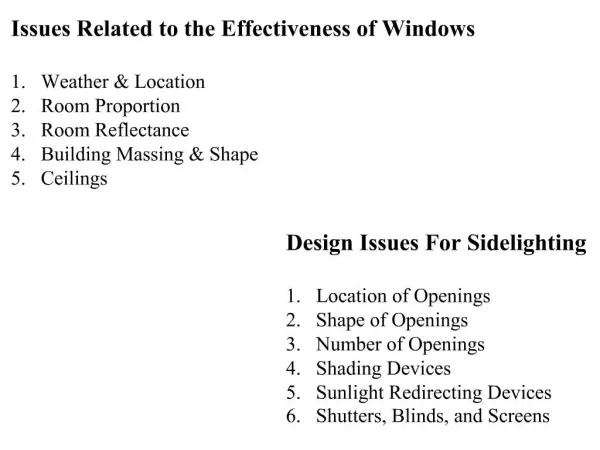
Daylight Design • Use the sun • Limit the sun’s direct component • Control “bounce” light • Balance heat gain, illuminance levels, contrast ratios • Be spectrally selective
Daylight Design • Perimeter lighting (atriums, lightwells) • Overhangs, fins • Light shelves • Shade controls (shutters) • Monitors, clerestories, skylights
Fenestration (glazing) • Fenestration – dual and triple glazing • Low E film or coatings • Argon or krypton filled • Visible Light Transmittance • Reflectance • SHGC or SC & U-value & VLT
Fenestration (glazing) • SHGC or SC • Solar Heat Gain Coefficient • Shading Coefficient (~.89 x SHGC) • U-value - heat conductivity, opposite of R-value (heat resistance), Low U-value, 0.25, is good • VLT = Visible Light Transmittance (1 to 100%) 70 is good • Values depend on climate
Site Considerations • Orientation • Santa Monica grid 46° off north – all windows get sun • Solar Access • Microclimate (e.g. morning fog) • Shading from geography • Reflective surfaces (e.g. ocean, pavement) • Neighboring structures (e.g. buildings) • Trees and landscaping
Daylighting Design • Shading • Shade south windows • Plant deciduous trees • Awnings, trellises, overhangs, light shelves • Vertical fins on east and west • Exterior shade devices • Arcades, colonnades, arbors
Contrast ratios • = Ratio of illuminances between two objects in same view • 3:1 is design goal for visual comfort • > 10:1 is intolerable (e.g. bright window in dark room)
Daylighting Design (cont’d) • Fenestration (glazing options) • Locate and size windows appropriately • North: excellent for daylighting • South: low E, high VT, low U • East: requires solar control • West: requires solar control • Don’t steal the view planes!
Daylighting Design (cont’d) • Fenestration (windows or glazing) • Low emissivity (low E) • High visible transmittance • Low U-value • High shading coefficient • Fritted or frosted glass