Understanding Polynomial Division: Long Division, Synthetic Division, and Related Theorems
This section focuses on the essential methods for dividing polynomials, including long division and synthetic division. Learners will explore the Remainder Theorem, which states that the remainder of a polynomial ( P(x) ) divided by ( x-c ) is ( P(c) ). The Factor Theorem is also covered, demonstrating that a polynomial ( P(x) ) has a factor ( x-c ) if ( c ) is a root. Students will engage in class work to apply these concepts through various exercises, fostering a deeper understanding of polynomial behavior and evaluation.

Understanding Polynomial Division: Long Division, Synthetic Division, and Related Theorems
E N D
Presentation Transcript
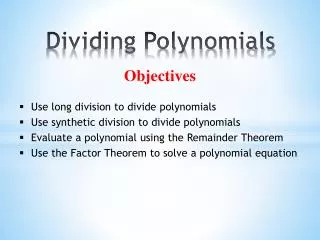
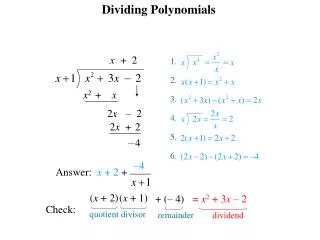
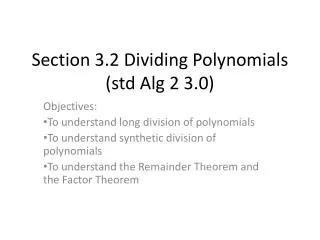
Section 3.2 Dividing Polynomials (std Alg 2 3.0) Objectives: To understand long division of polynomials To understand synthetic division of polynomials To understand the Remainder Theorem and the Factor Theorem
Class Work Divide. 1. 2.
Remainder Theroem If the polynomial P(x) is divided by x – c, then the remainder is the value P(c).
Ex 5. Use synthetic division and the Remainder Theorem to evaluate P(c).
Factor Theroem c is a zero of P if and only if x – c is a factor of P(x).
Ex 6. Use the Factor Theorem to show that x – c is a factor of P(x) for the given value of c and find all other zeros of P(x).
Class Work 3. Use synthetic division and the Remainder Theorem to evaluate P(c). 4. Use the Factor Theorem to show that x – c is a factor of P(x) for the given value of c and find all other zeros of P(x).
Ex 7. Find a polynomial of the specified degree that has the given zeros. degree 4; zeros -3, 0, 1, and 5