Understanding Volcanoes: Terminology, Magma Formation, and Eruption Types
480 likes | 590 Vues
This comprehensive guide explores essential concepts related to volcanoes, including terminology such as viscosity and volatiles. Discover how magma forms in various environments, such as subduction zones and spreading centers. Learn about different types of volcanoes, their eruptions, and the properties of basaltic, andesitic, and evolved lavas. Get insights into eruptive activities driven by viscosity, gas content, and temperature changes. This resource is perfect for anyone wanting to grasp the dynamics of volcanic systems.


Understanding Volcanoes: Terminology, Magma Formation, and Eruption Types
E N D
Presentation Transcript
New Terminology • Viscosity • Resistance of a material to flow • Ex: honey vs. tar • Volatiles • Gases dissolved in magma
Makin’ Magma… • Recall the asthenosphere… • Mostly solid—very close to melting point—small changes in T and P can create melt • Let’s make some Magma!
“Liquid Hot Mag-ma…” • Ways to make magma • Increasing T • A solid melts when it becomes hot enough • Decreasing P • Removal of P allows a solid to expand enough to melt • Addition of water • Wet rock melts at lower temperatures than dry rock
Magma Environments • Subduction Zones • Presence of water in subducting crust, increasing T and (generally low P) • Generally felsic extrusives
Magma Environments • Spreading centers • Ocean plates pull apart, asthenosphere rises to fill gap—decreasing P causes mantle to melt--mafic intrusvies and extrusives Plate motion Plate motion Upwelling mantle
Mantle Plumes • Decreasing P—hot mantle material from core-mantle boundary rises through surrounding mantle and melts as it rises • Mafic extrusives
Factors Controlling Size, Shape, and Type of Eruptive Activity • Size • Volume of lava erupted • time • Shape • Viscosity/composition • Explosivity • Viscosity/composition • Gas content
Basalt • High in Fe, Mg, Ca • Low in silicon • 1000-1200°C • Most common type of melt • Very fluid; up to ~6 mph • Very rarely explosive, mostly “lava rivers” • Deposits generally thin (several meters)
Shield Volcano • Gently sloped shield-shaped volcano several km high and 10s of km in diameter • Built up of many overlapping basalt lava flows • Mauna Loa is taller than Mt. Everest (10 km) but most of it is under water • Common above mantle plumes
Basalt Eruptions: Lava • Pahoehoe (“ropy”) • Surface cools but internal parts stay molten • “Skin” folds as material moves below
Basalt Eruptions: Lava • “Aa” – commonly believed to be expletive after walking on it • moves faster than Pahoehoe • Skin torn into jagged blocks which cascade down front of flow and are over ridden—like the tread on an earthmover
Lava Tubes • Lavas flowing in channels • Top slowly hardens over • Up to 60 km
Basalt Eruptions: Pillow Lavas • Erupted under water • Commonly from mid-ocean ridges • Lava in contact with water cools instantly • Lava inside remains hot and can break out
Basalt Eruptions: Fire-fountains • Occur when large amounts of gas rich lava erupted • Bubbles expand as magma moves to surface—causes lava to surge high into the air • Erupted lava is partially molten as it hits the ground—spatter • At very high eruption rates, spatter accumulates to form spatter-fed lava flows • Generally from linear fissures
Cinder Cone • Low volume, gas-rich, basaltic eruptions create fragments of material which cool quickly in air • Fragments pile up into cones which exist at the angle of stability for a random mass of stuff • Scoria—”lava rock” used in landscaping • Generally small <300m • Paricutín (from 2/20/43 to 1952, 424 m)
Evolved Lavas • Partial melting • Not all minerals have the same melting temperature • When a rock is heated, minerals with lowest melting temperatures melt first—generation of Na, K, Si rich magmas • Evolved lavas—high viscosity, high gas content • Andesite • Dacite • Rhyolite
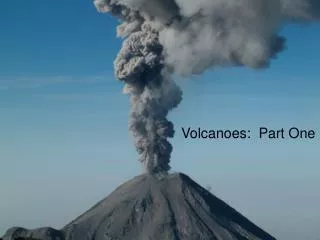
Stratovolcano • Also called composite volcanoes • Composed of alternating layers of lava(generally andesitic or dacitic composition) and pyroclastic (ash and blocks) material • Conical profile • Explosive personalities
“Evolved” Eruptions: Explosions • Imagine if sticky mass plugs top of volcano… • gas builds up and BOOM
“Evolved” Eruptions: Columns • Eruption Columns • Gases separate from magma during ascent due to decrease in pressure • Expand to a froth • Unlike in basalt, viscous magma prevents complete escape • Gas explodes violently at ~surface, propels particles of all sizes into atmosphere • Column propelled upward because it is buoyant—high temp + propelling force of exploding gasses
Pyroclastic Material • Anything shot out of a volcano • Range of particle sizes
Particles of All Sizes Ash-fall deposit Block Note layering
Pyroclastic Flows: Hot stuff, indeed • Occur when large volumes of material are erupted--atmosphere cannot support it • Hot rock and ash flow down sides of volcano at speeds of up to 160 km/hr (100 mph) • Hugs valleys and low spots • Fast (and hot) enough to travel across water • PF video
Caldera: Supervolcanoes • Predominantly rhyolite • Large volume eruptions of gas-rich magma causes surface to collapse • Commonly related to mantle plumes beneath continental crust or thinned continental crust • Long Valley Caldera – 600 km3 • A football field ~133,000 miles tall (61% of distance between Earth + Moon)
“Evolved” Eruptions: Lava • Low eruption temperature (compared to basaltic lava): 600-1000°C • Often occur after large, explosive eruptions (the lava is “flat” like a bottle of coke left open for too long) • Viscous: lava often has difficulty breaching crater—lava dome • If crater breached, very thick lava flows-move ~10 ft/day • Some flow fronts reach 150 m (or more)
Dacite Rhyolite
Mt. St. Helens • May 18th, 1980 • “Bulge” on northern flank—caused by development of a crypto-dome—a magma chamber in the body of the volcano • Magnitude 5 earthquake—unstable N. Flank collapses—debris avalanche • MSH height lowered by 1200’ • Left a crater 2 miles wide and .5 miles deep • 230 square miles of wilderness leveled • 58 people killed
Yellowstone • Yellowstone national park—three overlapping calderas—caldera at center of park 34 miles wide/1,500’ deep • Last eruption--~650,000 years ago • Repose period-- ~650,000 years • Will it erupt in our lifetime? • If it did, what kind of effects would it have?