Understanding Brain Differences: Myths and Facts
100 likes | 251 Vues
This discussion addresses common misconceptions about brain anatomy and function. It tackles claims regarding average brain sizes between genders, whether larger brains correlate with intelligence, and the assumed differences between left- and right-handed individuals. It also highlights unique features of male and female brains, such as the females' greater interconnectivity impacting reasoning skills. By dissecting these statements, we aim to enhance our understanding of brain science and debunk prevalent myths.


Understanding Brain Differences: Myths and Facts
E N D
Presentation Transcript
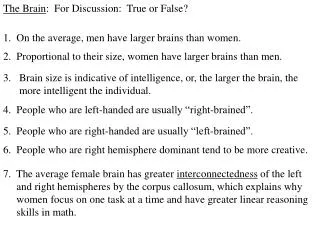
The Brain: For Discussion: True or False? 1. On the average, men have larger brains than women. 2. Proportional to their size, women have larger brains than men. • Brain size is indicative of intelligence, or, the larger the brain, the • more intelligent the individual. 4. People who are left-handed are usually “right-brained”. 5. People who are right-handed are usually “left-brained”. 6. People who are right hemisphere dominant tend to be more creative. 7. The average female brain has greater interconnectedness of the left and right hemispheres by the corpus callosum, which explains why women focus on one task at a time and have greater linear reasoning skills in math.
The Brain A. Cerebrum
A. Cerebrum 1. Cerebral cortex 2. Ventricles
2. Ventricles 3. Meninges Rx - Meningitis
B. Diencephalon 1. Thalamus
B. Diencephalon 2. Hypothalamus 3. Limbic System C. Brain Stem 1. Midbrain
C. Brain Stem 2. Pons 3. Medulla oblongata
Rx - Stroke C. Brain Stem 4. Reticular Formation Rx - Sleep Disorders