Understanding Stars and Constellations: Lessons on Nearest Stars to Earth
This educational lesson explores the fundamental concepts of stars and constellations. Students will learn about the nearest stars to Earth, including Alpha Centauri (4.2 light-years), Procyon A (11.4 light-years), and Sirius A (8.6 light-years), as well as the Sun, located just 4 light-years away. The lesson emphasizes the importance of stars as glowing gas spheres that emit heat and light, and the role of constellations in navigation. A vocabulary review and discussion on the utility of constellations will enhance understanding.

Understanding Stars and Constellations: Lessons on Nearest Stars to Earth
E N D
Presentation Transcript
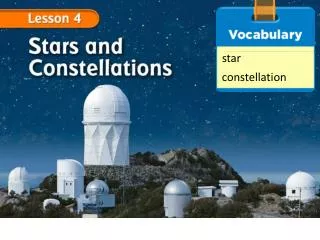
star constellation Lesson 4 Splash
Nearest Stars to Earth Lesson 4 a What are stars? Earth Ross 154 9.5 light-years Alpha Centauri 4.2 light-years Procyon A 11.4 light-years Sirius A 8.6 light-years Sun 4 0 1 2 3 7 8 9 11 12 5 6 10 Light-Years
What are constellations? Southern Hemisphere Northern Hemisphere Lesson 4 b
What is the Sun like? Lesson 4 c Here you can see parts of the Sun that you cannot see from Earth.
Main Idea Main Idea Review What are stars? Stars are hot, glowing spheres of gases that give off energy.
Vocabulary Vocabulary Review A glowing sphere of gases that gives off heat and light energy is a ____________. A ____________ is a group of stars that suggest a figure or design. constellation star
Fact and Opinion Are constellations useful to people today? State your opinion. Support your opinion with at least one fact. G.O. Review Constellations can be used to find your direction at night. Constellations are useful. End of Lesson