Download
1 / 12
120 likes | 238 Vues
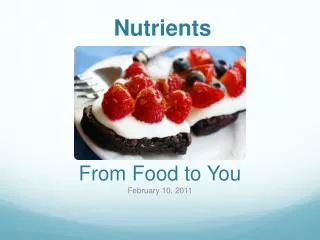
Nutrients. From Food to You. February 10 , 2011. Nutrient. A substance that performs a specific job in your body. More than 40 nutrients belong in six main groups! What Nutrients do for you: Give you energy Build and repair body cells Regulate body processes. The Six Nutrients.

E N D
Nutrients From Food to You February 10, 2011
Nutrient • A substance that performs a specific job in your body. • More than 40 nutrients belong in six main groups! • What Nutrients do for you: • Give you energy • Build and repair body cells • Regulate body processes
The Six Nutrients • Carbohydrate • Fats • Protein • Water • Vitamins • Minerals
Carbohydrates • Main energy source • Simple: • Sugar • Complex: • Starch • Fiber • Foods with Carbohydrates • Sugars occurring naturally in foods • Fruit and milk • Whole grains, legumes, and many vegetables
Fats • Fats provide: • Energy • Flavor and texture • Healthy skin and normal growth • Transports some vitamins and slows digestion • Insulates you from heat and cold • Types • Saturated: Solid at room temperature • Raises cholesterol • Unsaturated: Liquid at room temperature • Lowers cholesterol • Trans: Oils hydrogenated/processed to be firm • Raises cholesterol
Proteins • Substances body uses to build new cells and repair injured ones • Needed for growth and fighting disease • Made of 22 amino acids – Nine are essential • Extra protein doesn’t build extra muscles – Physical activity DOES! • Types: • Complete – all 9 essential amino acids • Soybeans and animal sources • Incomplete – lack one or more essential amino acids • Plant sources, beans, peas, grains, nuts • Eat a variety of these foods!
Water • Every body cell contains water • Water carries nutrients • Helps regulate body temperature • Helps eliminate waste • Drink water every day!
Vitamins • Needed in small amounts • Does not provide energy or build body tissue • Regulate body processes and helps other nutrients do their work • Two types: • Water-soluble – Dissolve in water • Thiamin, Riboflavin, Niacin, Folate, Vitamin B & C • Fat-soluble – Dissolve in fat • Vitamin A, D, E, and K
Minerals • Regulate body processes • Some become a part of your body in the form of cells, fluids, muscles, teeth, and bones • Minerals work together • Examples: • Calcium, Phosphorus, Magnesium, Sodium, Chloride, Potassium, Iron, Zinc, Fluoride, etc.
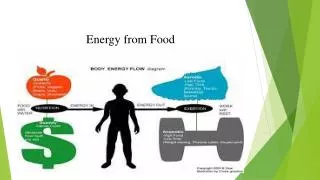
Energy in Food • Calorie – Unit that measures energy from food and energy used by the body • Three nutrients provide energy: • Carbohydrates (1 gram = 4 calories) • 45-65% of daily calories • Proteins (1 gram = 4 calories) • 10-35% of daily calories • Fats (1 gram = 9 calories) • 25-35% of daily calories • No more than 10% coming from saturated fats
Energy Your Body Uses • For Body Processes: • Breathing, circulating blood, building cells, etc. • This makes up your metabolism • BMR – Basic Metabolic Rate • Speed at which the body uses energy for body processes • Differs from person to person • For Physical Activity: • Every movement you make • The amount you use depends on how active you are
Energy Balance • Consuming the same amount of energy (calories) as your body uses • Maintains your weight • How does this affect your body weight?