Tertiary Structures
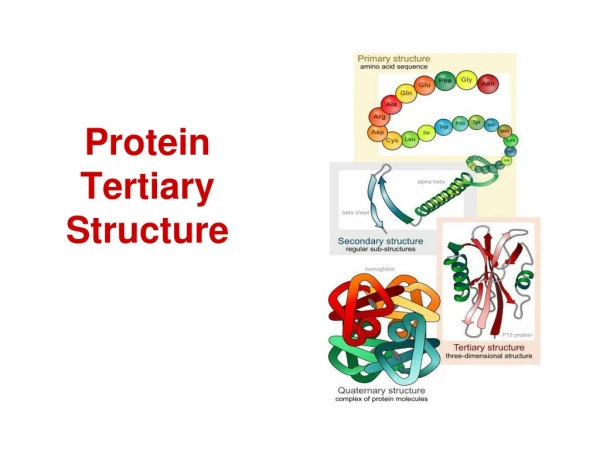
Explore the unique tertiary structures of proteins such as myoglobin, RNAse, cytochrome C, and lysozyme, each showcasing distinct folding patterns comprising of alpha-helix and beta-sheet arrangements. Discover the interior composition of proteins, the role of hydrophobic residues, disulfide bonds, and prosthetic groups in stabilizing their structures. Unearth supersecondary structures, folding regularities like beta-alpha-beta loops, alpha-alpha corners, and the importance of polypeptide chain adjacency. Delve into the SCOP classification, understanding the hierarchy from class to superfamily. Dive into the quaternary structure, examining multimers, dimers, oligomers, and protomers.

Tertiary Structures
E N D
Presentation Transcript
Tertiary Structures • Cf myoglobin, RNAse, cytochrome C, and lysozyme • Mb – high %age of -helix • Cytochrome C –less -helix, some -sheet. • RNAse – more -sheet • Lysozyme – both in good measure
Interior of protein • Interior contains mostly hydrophobic residues which stabilize structure, • But small proteins need more bonds • Disulfide • Other prosthetic groups (heme, e.g.) covalently attached
Supersecondary structures (motifs or folds) • Combinations which recur • Organization of structures (SCOP)
Folding regularities (not exhaustive) • -- loop • - corner
Folding regularities (cont) • -helices and -sheets usually are found in different layers (they don’t readily H-bond to each other)
Folding regularities (cont) • Polypeptide chains adjacent in primary structure usually adjacent in tertiary structure
Folding regularities (cont) • No crosses or knots
Folding regularities (cont) • The conformation most stable with a right hand twist • sheets have a crossover strand, which usually is a “right handed connection” • Twisting larger scale structures result
SCOP • Class • Fold • Family- significant primary sequence similarity and/or similar structure and function (globins, e.g.) • Superfamily – significant structural and funcional similarity (little primary structure similarity)
Quaternary Structure • Multimers • Dimers • Oligomers • Protomers