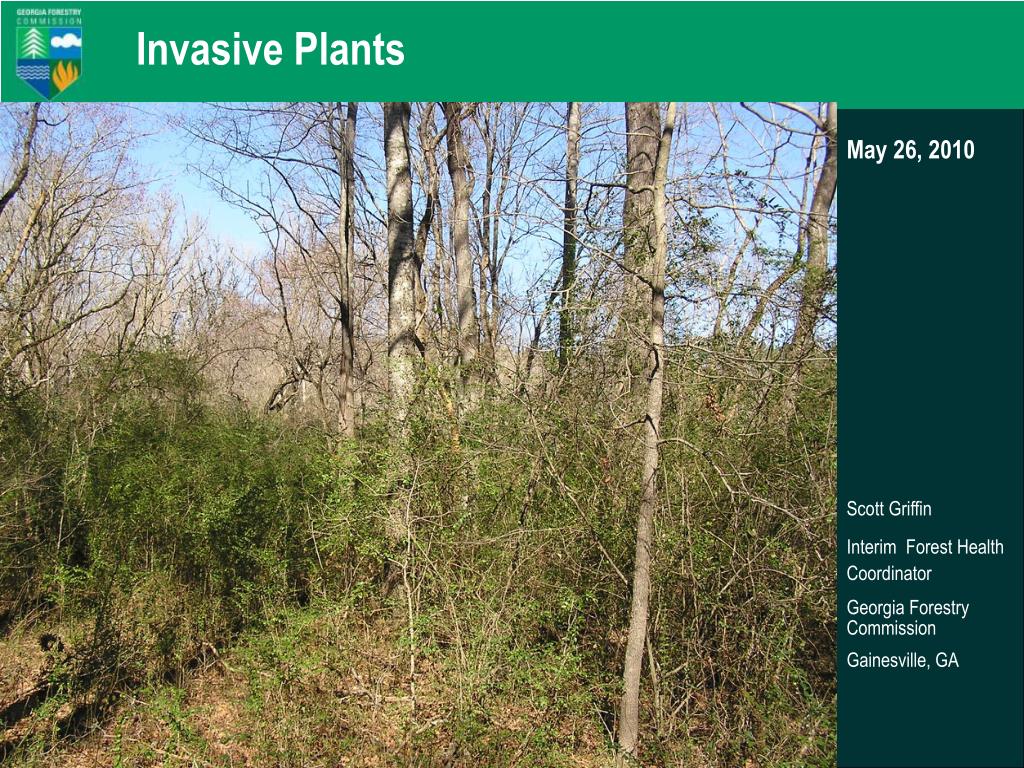
Invasive Plants May 26, 2010 Scott Griffin Interim Forest Health Coordinator Georgia Forestry Commission Gainesville, GA
Invasive Plants Major invasive plants impacting forestry in the South…
Top 12 Species* • Top 11 species removing honeysuckle and fescue The Dirty Dozen
Chinese Tallowtree (Triadica sebifera)
Tallowtree, Popcorntree Triadica sebifera Percent of Subplots In a County Occupied Not Detected < 10 10 - 20 20 - 50 50 - 80 80 - 100 USDA Forest Service SRS FIA database March 2008 Miller and Chambliss, Auburn
Chinese Tallowtree (Triadica sebifera)
Non-native roses (Rosa spp.)
Nonnative Roses Rosa spp. Percent of Subplots In a County Occupied Not Detected < 10 10 - 20 20 - 50 50 - 80 80 - 100 USDA Forest Service SRS FIA database March 2008 Miller and Chambliss, Auburn
Japanese Climbing Fern (Lygopodium japonicum)
Japanese Climbing Fern Lygodium japonicum Percent of Subplots In a County Occupied Not Detected < 10 10 - 20 20 - 50 50 - 80 USDA Forest Service SRS FIA database March 2008 Miller and Chambliss, Auburn
Japanese Climbing Fern Dies back in late winter Dead vines providing a trellis for reestablishment.
Japanese Climbing Fern – fire hazard
Japanese Climbing Fern – impacts straw industry…
Chinese Privet (Ligustrum spp)
Not Detected < 10 10 - 20 20 - 50 50 - 80 80 - 100 All Invasive Privets Ligustrum spp. Percent of Subplots In a County Occupied USDA Forest Service SRS FIA database March 2008 Miller and Chambliss, Auburn
Chinese Privet – invasion began long ago…
Winter Foliar Treatment – glyphosate 3-5% February April
Chinese Privet invades upland areas too… Numerous low-growing small stems in pine stand = good choice for broadcast understory treatment Burning may be good first step Escort XP® (1 ounce per acre) – high volume
Chinese Privet control options Foliar Treatments: Escort XP®(1 oz per acre + 0.25% non-ionic surfactant) High Volume Broadcast. Good choice for pine stands but may damage hardwood overstory (Ash, Elm, Dogwood and Cherry are susceptible to root uptake from Escort). Growing season. Glyphosate(2-5% solution with water) applied as a directed foliage spray DURING THE DORMANT SEASON. Good choice for hardwood stands with numerous sprouts or stands with desirable plants near privet. 41% active ingredient products. Accord Concentrate®(up to 7 pints per acre) applied aerially DURING THE DORMANT SEASON (within piedmont region – GFC trial). 54% active ingredient product labeled for areas where standing water occurs. http://www.gatrees.org/ForestManagement/documents/AerialGlyphosateApplicationtoControlPrivet2009.pdf
Chinese Privet control options • Cut Surface Treatments: as a cut surface or injected into the cambium. Safe around desirable trees where privet must be removed. • Krenite®(mixed 50-50 with water plus surfactant) • Arsenal AC® (5% solution with water plus surfactant) • Glyphosate (mixed 50-50 with water) – 41% active ingredient products • Garlon 3A®(20% solution with water plus surfactant) • Basal Bark Treatments: Safe around desirable trees where privet must be removed. • Garlon 4®(20% plus crop oil) applied as a basal bark treatment. Good treatment option for large privet with single stems and bushy canopy. • Other Considerations: • Privet eradication will take at least 2 treatments over 2 growing seasons • Most privet seed will germinate within one year of maturing • Re-sprouts should be at least 24” before treating
What is the First Step in Eradication?
Aerial Privet trial in Mature Hardwood Forests Glyphosate treatment applied via helicopter in the dormant season Major Questions? Will it damage the hardwood overstory? Can it provide an initial control of privet?
Aerial Privet trial in Mature Hardwood Forests http://www.gatrees.org/ForestManagement/ForestHealth.cfm
Aerial Privet trial - Methods • Sites selected at 2 state parks (Fort Yargo and Hard Labor Creek) • 2 Treatment areas on each park established • 3% & 6% solutions of Accord Concentrate® (54% ai) • 3% (0.45 gpa) & 6% (0.9 gpa) • 0.5% Entry II ® surfactant (0.075 gpa) • 15 gallons / acre applied February 6 & 7, 2009
Aerial Privet trial - Application
Aerial Privet trial - Application
Aerial Privet trial – plots… • 3 plots established in each area • 1/10th acre circular plots • Plot location insure all major tree species would be represented • All trees measured – species, dbh, health condition • 5 or more 1” dbh privet measured and tagged / plot • Privet regeneration measured within 3’ radius of plot center
Aerial Privet trial – Tree Composition
Aerial Privet trial – Fort Yargo plots (Trees)
Aerial Privet trial – Fort Yargo plots
Aerial Privet trial – privet impact Healthy Dead
Aerial Privet trial – tree impact
Aerial Privet trial – privet regeneration impact
Aerial Privet trial – final thoughts • Treatments at both concentrations had significant impact on the privet • Privet regeneration was also impacted • Neither concentration impacted tree canopy (except Persimmon) • Privet is not eradicated…must follow-up with ground treatments • Seed remain viable for 1 growing season • Aerial cost is similar (or cheaper) than ground applications • $170 / acre - 6% • $150 / acre - 3% (GFC costs 2010 - $65/acre) • Treatment window may vary each year – overstory dormancy is critical • Avoid below freezing applications • Coastal plain trial – winter 2009 – 2010 (magnolia, sweetbay, switch cane)
Partnerships & Thanks! Dow AgroSciences