D. Joseph Fleming President
This document chronicles the historical relationship between transportation technology and safety regulations, focusing on anti-lock brakes introduced in the 1970s and their implications for the trucking industry. It highlights issues like vehicle breakdowns, emissions, and maintenance challenges over the years, alongside the successful advancements made through collaboration among government, manufacturers, and users. Notable case studies illustrate the impact of legislation and technology on safety, efficiency, and costs, stressing the continued need for innovation in the truck industry.
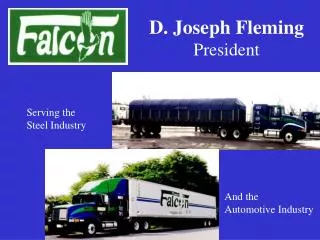

D. Joseph Fleming President
E N D
Presentation Transcript
D. Joseph Fleming President Serving the Steel Industry And the Automotive Industry
PROBLEMS • Breakdowns
PROBLEMS • Breakdowns • Feed the Horses
PROBLEMS • Breakdowns • Feed the Horses – with only low sulpher HAY
PROBLEMS • Breakdowns • Feed the Horses • Accidents
PROBLEMS • Breakdowns • Feed the Horses • Accidents • AndEMISSIONS
PROBLEMS • And theEMISSIONS SOLUTION
PROBLEMS • And theEMISSIONS SOLUTION TECHNOLOGY
History The McNicholas General Cartage and Storage fleet in 1918: Two 3-tonners and one 2-tonner.
Anti-lock Brakes Mandated • The Government Mandated Anti-lock brakes on all new Trucks In 1974
Anti-lock Brakes Mandated • The Government Mandated Anti-lock brakes on all new Trucks In 1974 • Millions of Dollars were spent on R&D
Anti-lock Brakes Mandated • The Government Mandated Anti-lock brakes on all new Trucks In 1974 • Millions of Dollars were spent in R&D • People purchased the trucks
Anti-lock Brakes Mandated • The Government Mandated Anti-lock brakes on all new Trucks In 1974 • Millions of Dollars were spent in R&D • People purchased the trucks • Failures went crazy - Trucks were on the side of the road. AND
Anti-lock Brakes Mandated • The Government Mandated Anti-lock brakes on all new Trucks In 1974 • Millions of Dollars was spent in R&D • People purchased the trucks • Failures went crazy - Trucks were on the side of the road. AND • The Anti-lock rule was rescinded
Anti-lock Brakes - Part II • A TMC Group of Suppliers, Manufacturers, OEMs and Government worked together
Anti-lock Brakes - Part II • A TMC Group of Suppliers, Manufacturers, OEMs and Government worked together • They Developed Standardized Processes, Terminology's, Training Methods, Maintenance Methods, • and
Anti-lock Brakes - Part II • A TMC Group of Suppliers, Manufacturers, OEMs and Government worked together • They Developed Standardized Processes, Terminology's, Training Methods, Maintenance Methods, • and • New Legislation was Passed
2000 Anti-lock Brakes Mandated • and People purchased the trucks
2000 Anti-lock Brakes Mandated • It was a Great Success • Quality was Excellent • Drivers and Mechanics Understood Them • And Liked them and
2000 Anti-lock Brakes Mandated • It was a Great Success • Quality was Excellent • Drivers and Mechanics Understood Them • And Liked them and • Safety Improved
2000 Anti-lock Brakes Mandated • It was a Great Success • Quality was Excellent • Drivers and Mechanics Understood Them • And Liked them and • Safety Improved & THEY WORK
2000 Anti-lock Brakes Mandated • It was a Great Success • Quality was Excellent • Drivers and Mechanics Understood Them • And Liked them and • Safety Improved & THEY WORK TEAMWORK = SUCCESS
2000 Anti-lock Brakes Mandated • Falcon Bought Them • We were an Early Customer • We saw the Benefits and we bought the trucks
Falcon & New Technology • Falcon Purchased Qualcomm very Early • Falcon was an Early Purchaser of Electronic Engines • We saved fuel • Increased Durability and Engine Life • Reduced Maintenance Costs • Had Access to Engine Performance Data in the ECM
Falcon & Electronic Engines • The Technology was Right for the Challenge • The Engines were well Designed and Tested • Cleaner Air was a Bi-Product - Not the Only Product • Legislation and Co-Operation Worked TEAMWORK = SUCCESS
Falcon & New Technology • Falcon's Position on2002 Engines • What are the Benefits for Falcon ? • Current Trucks are Performing Better • Engines are Living Longer • MPG is Good and Costs are Down WE ARE RUNNNING THE TRUCKS LONGER
2002 ENGINES & FUEL COSTS • WHAT IF FALCON BOUGHT 100 - 2002 ENGINES • Test Group used 160,397 Gallons of Fuel - 5 Months • We spent $252,736 on that Fuel • Annualized - 385,000 Gallons and $606,500
2002 ENGINES & FUEL COSTS If the loss in MPG is 4.7% EXTRA FUEL COSTS - $90,650 PER YEAR If the loss in MPG is 7.5% EXTRA FUEL COSTS - $149,000 PER YEAR If the loss in MPG is 14.5% EXTRA FUEL COSTS - $310,000 PER YEAR 198,800 extra Gallons of Fuel
2002 ENGINES & FUEL COSTS The Commercial Trucking Industry consumes 28 billion gallons of Diesel Fuel per Year 14.5% Results in over 4 Billion Gallons of Extra Fuel Annually for the Industry CAN WE AFFORD CLEAN AIR ?
2007 ENGINES Ken Veith, principal of ACT Research said “2007 engines are expected to increase truck costs by about $10,000 and diminish fuel economy by another 5% WHAT CAN WE DO ?
2007 ENGINES Recommendations from Citizen Joe Fleming Temporarily Suspend the Implementation of the 2007 Rule Let the 2002 Engines Technology Mature Create a Joint Government, Supplier & User Task force Use ATA/TMC as the forum for this Task Force Find the Best Answer - for all Parties Get Possible Technology into the Fleets ASAP Keep Reliability Data Using VMRS information Publish Test Data & Reliability Information on the NET WHAT CAN WE DO ?
2007 ENGINES Recommendations from Citizen Joe Fleming Use the TMC Web Sight to Post the Information Do What is Best for the Entire Country - Not Just Air Quality Work for Tax Credits for Users of Clean Vehicles Similar to Automobiles Finalize the Distribution Network for Low Sulpher Fuel AND REMEMBER TEAMWORK = SUCCESS
D. Joseph Fleming President THANK YOU