Digital Intellectual Property Final Project Presentation
120 likes | 237 Vues
This presentation explores advanced modulation techniques in digital communication, particularly focusing on Quadrature Amplitude Modulation (QAM). Key topics include the removal of the FIR raised cosine filter to address inter-symbol interference (ISI) and dispersion issues. We present the original and revised architectures of our system, discussing various types of QAM such as rectangular, odd-bit symmetric, and hybrid QASK. Also covered are the implications on bit error rates and power consumption, alongside solutions and methodologies derived from established literature in communication systems.


Digital Intellectual Property Final Project Presentation
E N D
Presentation Transcript
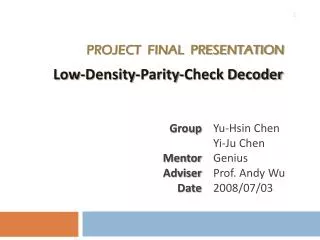
Digital Intellectual Property Final Project Presentation Team 2 Architecture Review R95922110 陳其蔚 B92902006 杜承翰
Revised Architecture The FIR raised cosine filter is removed. (Why?)
ISI and Dispersion Interference
Remove the Filter • Original architecture has impulse generators • Inter-symbol Interference (ISI) due to dispersion • No need to be considered in digital circuit
QASK Map • Rectangular QASK • Odd-bit Symmetric QASK • Gray Code
QASK Map (continued) • Another Odd-bit QASK from IEEE 802.15 proposal
QASK Map (continued) • Hybrid • Difficult modulation
Bit Error Rate and Power Consumption • What’s the difference between 16QAM, 32QAM, 64QAM, …? • Our method
Tunable QAM • Difficulty • Solution
Schedule • Finished • Rectangular 16QAM subsystem • Relating knowledge collected and realized • Following task • Other type of QAM map • Modulator I/O • C model of demodulator
Reference • “Odd-Bit Quadrature Amplitude-Shift Keying” by JOEL G. SMITH, MEMBER, IEEE • “Reasons to Use Non-squared QAM Constellations With Independent I & Q In PAN Systems” (http://www.vocal.com) by Victor Demjanenko Ph. D., Paul Marzec MS, and Alberto Torres Ph.D. • “HIGHER-ORDER BLIND SIGNAL FEATURE SEPARATION: AN ENABLING TECHNOLOGY FOR BATTLEFIELD AWARENESS” by Wei Su* and John A. Kosinski, U.S. Army CERDEC, Ft Monmouth, NJ 07703 • Signals and Systems, 1997, 2nd Ed. by Oppenheim and Willsky, Prentice Hall • Communication Systems, 4th Edition, Simon Haykin