Understanding the Impact of Remote Learning on Student Engagement: A Comprehensive Study
80 likes | 192 Vues
This study examines the effects of remote learning on student engagement, a topic increasingly relevant in the digital age. Our team chose this subject to explore its implications for educational efficiency and student well-being during unprecedented times. We conducted a thorough literature review, drawing on various scientific studies and credible sources to highlight prior research findings. Our analysis presents survey results through descriptive statistics and qualitative variables, with clear visual representations. The study identifies limitations and suggests avenues for future research to enhance understanding of remote education's impact.


Understanding the Impact of Remote Learning on Student Engagement: A Comprehensive Study
E N D
Presentation Transcript
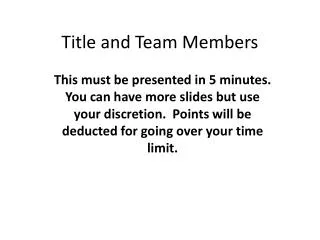
Title and Team Members This must be presented in 5 minutes. You can have more slides but use your discretion. Points will be deducted for going over your time limit.
Purpose of Study & Research Hypothesis • Tell us why this is important? • Why did your group choose this topic? • Make us a believer!
Background Info of Previous Study, Research Quotes • Find similar research studies from scientific journals and other credible sources. • Remember any direct quotes must be cited like: (Last Name, First Initial.,Year, p. #). • Any paraphrased quotes must be cited like: (Last Name, First Initial., Year). • Direct quote from website (www.apa.com, year, p.# if printed). • Paraphrased quote from website (www.apa.com, year). • You DO NOT need a works cited page on your power point since it will be submitted with your paper.
Definitions of Variables • Highlight Survey Questions • Define any Likert scale used on the survey
Descriptive Statistics Qualitative Variables -Tables and Bar Graphs Quantitative Variables -Mean, Mode, Standard Deviation, etc.
Conditions for Inference • Random • Normal • Independent Your group may not be able to meet all conditions – do the best you can and explain why certain conditions cannot be met.
Inference Results • Graphs of any major results or finding • Explanation of P-value and alpha value
Conclusion • Conclusion • Limitations (extraneous variables, confounding variables, response Bias, sampling Bias) • Ideas for future research