Understanding the Architecture and Functionality of Skype's Peer-to-Peer Protocol
This overview explores the technical architecture of Skype, focusing on its super node functionality, which allows users with public IP addresses and adequate resources to facilitate connections for others. We discuss key methods for firewall and NAT traversal, including the use of STUN and TURN protocols. Additionally, we highlight Skype's encryption capabilities, smart routing for efficient switching, and its simplified user interface. The impact on traditional telecommunications providers is considered, alongside a case study on the peers’ interconnectivity and super node effectiveness based on real login data.


Understanding the Architecture and Functionality of Skype's Peer-to-Peer Protocol
E N D
Presentation Transcript
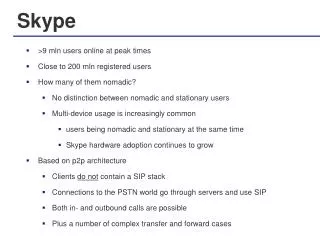
Overview • Any node with a public IP address having sufficient CPU, memory and network bandwidth is a candidate to become a super node • A peer cannot control whether it becomes a SN • An ordinary host must connect to a super node and must register itself with the Skype login server
Techniques used in Skype • Firewall and NAT traversal • SC uses a variation of the STUN and TURN protocols to determine the type of NAT and firewall • Global decentralized user directory • Intelligent routing (fast switching) • Security (encryption) • Super-simple UI • Impact on fixed-line operator and mobile phone operator
More Details • The Skype protocol is encrypted, so it is not possible to truly “reverse engineer” it, but guess what it does • A case study: Baset and Schulzrinne, “An analysis of the Skype peer-to-peer Internet telephony protocol”, Infocom 2006 • Super node • A few special “bootstrap” SNs help SC find login server • A SN helps a SC determine whether it is behind NAT or UDP-blocking firewall • A SN helps a SC search a user • Any user logged in during the last 72 hours can be found • This is validated by the paper • A SN helps two SC behind firewalls to relay voice packets
Number of SN seen After 8163 successful logins
Distribution of SNs Note, majority (83.7%) found in US