Benchmarking Ultra-High Performance Architecture for Embedded Defense Signal Processing
This study presents comprehensive hardware benchmark results for a cutting-edge multi-threaded array processing technology designed for embedded defense signal and image processing applications. It details the capabilities of ClearSpeed's Multi-Threaded Array Processor Architecture (MTAP), focusing on performance validation, specifically in pulse compression tasks. The findings support strategic technology investment decisions in radar and related platforms. Through rigorous testing, this architecture achieves exceptional performance metrics, demonstrating significant potential for both military and commercial applications.

Benchmarking Ultra-High Performance Architecture for Embedded Defense Signal Processing
E N D
Presentation Transcript
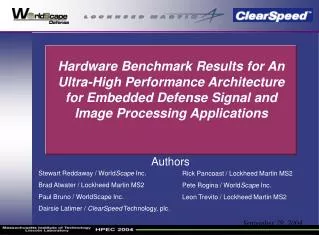
Hardware Benchmark Results for An Ultra-High Performance Architecture for Embedded Defense Signal and Image Processing Applications Authors Stewart Reddaway / WorldScape Inc. Brad Atwater / Lockheed Martin MS2 Paul Bruno / WorldScape Inc. Dairsie Latimer / ClearSpeed Technology, plc. Rick Pancoast / Lockheed Martin MS2 Pete Rogina / WorldScape Inc. Leon Trevito / Lockheed Martin MS2 September 29, 2004
Overview • Work Objective • Provide working hardware benchmark for Multi-Threaded Array Processing Technology • Enable embedded processing decisions to be accelerated for upcoming platforms (radar and others) • Validate Pulse Compression benchmark with hardware, and with data flowing from and to external DRAM • Support customers’ strategic technology investment decisions • Share results with industry • New standard for performance AND performance per watt
ClearSpeed’s Multi Threaded Array Processor Architecture – MTAP Fully programmable at high level with Cn (parallel variant of C) Hardware multi-threading Extensible instruction set Fast processor initialization and restart High performance, low power ~ 10 GFLOPS/Watt Architecture Architectural DSP Features: • Multiple operations per cycle • Data-parallel array processing • Internal PE parallelism • Concurrent I/O and compute • Simultaneous mono and poly operations • Specialized execution units in each PE • Integer MAC, Floating-Point Units • On-chip memories • Instruction and data caches • High bandwidth PE “poly” memories • Large scratchpad “mono” memory • Zero overhead looping • Concurrent mono and poly operations • Scalable internal parallelism • Array of Processor Elements (PEs) • Compute and bandwidth scale together • From 10s to 1,000s of PEs • Multiple specialized execution units per PE • Multiple high speed I/O channels
Processor Element Structure ALU + accelerators: integer MAC, Dual FPU, DIV/SQRT High-bandwidth, multi-port register file Closely-coupled SRAM for data High-bandwidth per PE DMA: PIO, SIO Architecture • High-bandwidth inter-PE communication • Supports multiple data types: • 8, 16, 24, 32-bit, ... fixed point • 32-bit IEEE floating point
Applications • Power Comparison Results (Table presented at HPEC 2003) ** 2.0 Watts was the worst case result from Mentor Mach PA Tools. Actual Measured Hardware Results < 1.85 Watts HPEC 2003 Cycle Accurate Simulations were validated on actual hardware. Results matched to within 1%.
Benchmark WorldScape and Lockheed Martin collaborated to provide demonstration using realistic Pulse Compression data on actual hardware Pulse Compression Input Data FFT Reference FFT Complex Multiply IFFT Output Data • 1K FFT and IFFT implemented on 8 PEs with 128 complex points per PE (8 FFTs performed in parallel over 64 PEs) • Pulse Compression based upon optimized instructions: FFT, complex multiply by a realistic reference FFT, IFFT • 32-bit IEEE standard floating point
Benchmark DRAM DRAM MTAP #1 MTAP #2 Per Second ( /s) Per Second Per Watt ( /s/W) FFTs (within PC) 68800* 37200 3 1 2 Host Pulse Compression 34680 18744 GFLOP 3.73 2.02 Benchmark Measurements: Validate Pulse Compression performance with hardware and with data flowing from and to external DRAM (1 MTAP processor) * Adjusted for CM = 73000 FFT/s, 39400 FFT/s/W 1) Input Data and reference Function loaded from Host onto DRAM 2) Data input from DRAM to MTAP #1, processed, and output into DRAM 3) Results returned to Host for display
Benchmark Pulse Compression Input (MatLab) Pulse Compression Reference (MatLab) • Frequency Domain Reference • 10 us • LFM chirp up • 1024 samples • Hamming weighting • Bit-reversed to match optimized implementation • 1 KHz PRF (1ms PRI) • 20 MHz sampling rate • 870 samples • Echo • 10 us pulse • LFM chirp up • 200 samples Pulse Compression Output (MatLab) • 671 samples out of PC
Benchmark Pulse Compression Input/Output (Actual) Pulse Compression Reference (Actual)*
Benchmark DRAM DRAM MTAP #1 MTAP #2 Per Second ( /s) Per Second Per Watt ( /s/W) FFTs (within PC) 56800* 30700 3 2 1 Host Pulse Compression 28610 15465 GFLOP 3.08 1.67 Benchmark Measurements: Validate Pulse Compression performance with hardware and with data flowing from and to external DRAM (Average Performance across 2 MTAP processors) * Adjusted for CM = 60200 FFT/s, 32510 FFT/s/W 1) Input Data and reference Function loaded from Host onto DRAM 2) Data input to MTAP #1 and (via MTAP #1) to MTAP #2, processed, and output (via MTAP #1) into DRAM 3) Results returned to Host for display
Summary Hardware validation of HPEC 2003 results to within 1% World-class radar processing benchmark results Optimized Pulse Compression functions modified using COTS SDK and integrated onto Host platform Wide Ranging Applicability to DoD/Commercial Processing Requirements • VSIPL Core Lite Libraries under development Application Areas • Image Processing • Signal Processing • Compression/De-compression • Encryption/De-cryption • Network Processing • Search Engine • Supercomputing Applications