Download
1 / 27
270 likes | 387 Vues
This paper presents a detailed analysis of the transverse polarization of hyperons, particularly focusing on the Λ particle, in inclusive hadron production. The study highlights the dependence of polarization on transverse momentum (pT) and Feynman-x (xF), emphasizing the independence of polarization magnitude from beam energy. Through examining various theoretical models, including pQCD and parton distribution functions, the work aims to shed light on the spin structure and asymmetries involved in hyperon production, calling for new experimental data to refine our understanding of the underlying dynamics.

E N D
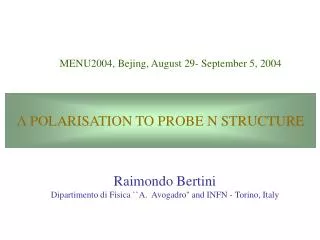
MENU2004, Bejing, August 29- September 5, 2004 Λ POLARISATION TO PROBE N STRUCTURE Raimondo Bertini Dipartimento di Fisica ``A. Avogadro'' and INFN - Torino, Italy
Transverse polarisation , normal to the production plane [1] • strong pT dependence: • increase with pT up to • ~1GeV/c, then constant • strong xF dependence: • near with xFlinear increase of polarisation in inclusive hadron production [1]L. G. Pondrom, Phys. Rep. 122(1985)57
Transverse polarisation , normal to the production plane [1] polarisation in inclusive hadron production • polarisation magnitude • indipendent of beam energy [1]L. G. Pondrom, Phys. Rep. 122(1985)57
polarisation transfer: CFR TFR
Hyperon production Spin Asymmetries • production in unpolarised pp-collision: Several theoretical models: • Static SU(6) + spin dependence in parton fragmentation/recombination [1-3] • pQCD spin and transverse momentum of hadrons in fragmentation [4] • [1] T.A.DeGrand et al.,Phys. Rev D23 (1981) 1227. • [2] B. Andersoon et al., Phys. Lett. B85 (1979) 417. • [3] W.G.D.Dharmaratna, Phys. Rev. D41 (1990) 1731. • [4] M. Anselmino et al.,Phys. Rev. D63 (2001) 054029. Analysing power Data available for DNN: 3.67 GeV/c DNN < 0 13.3 -18.5 GeV/c DNN~ 0 200 GeV/c DNN > 0 DNN @ 40 GeV/c MISSING Depolarisation Key to distinguish between these models
κT-dependent Parton Distributions Twist-2 PDFs f1, g1 studied for decades: h1 essentially unknown
Λ polarisation with longitudinally polarised lepton beam along ê³
Unpolarised beam and longitudinally pol. target Transverselly polarised target
Assuming u-quark dominance R. L. Jaffe Phys. Rev. D54 (1996) R6581
Hyperon production Spin Asymmetries Polarised target: . Transverse target polarisation Existing data: PS185 (LEAR) [2] [1] K.D. Paschke et al., Phys. Lett. B495 (2000) 49. [2] PS185 Collaboration, K.D: Paschke et al., Nucl. Phys. A692 (2001) 55. [1] complete determination of the spin structure of reaction Models account correctly for cross sections. Models do not account for or . NEW DATA NEEDED
Open Charm ΔG longitudinally polarised • Open charm from production • and subsequent weak decay • low branching ratio: B.R. = 0.9% • huge self-analysing asymmetry: [1] Smith Vogt Z. Phys. C75 (1997)271
Beam and Target Key features: Generation of intense, high-quality secondary beams of rare isotopes and antiprotons. Two rings: simultaneous beams. SIS 100 Tm SIS 300 Tm U: 35 AGeV p: 90 GeV
Drell-Yan Di-Lepton Production Scaling: Full x1,x2 range . needed [1] Anassontzis et al., Phys. Rew. D38 (1988) 1377
Drell-Yan Di-Lepton Production Why Drell-Yan? Asymmetries depend on PD only (SIDIS→convolution with QFF) Why ? Each valence quark can contribuite to the diagram Kinematics
Drell-Yan Asymmetries — Polarised beam and target Uncorrelated quark helicities access chirally-odd functions TRANSVERSITY • Ideal because: • h1 not to be unfolded with fragmentation functions • chirally odd functions • not suppressed (like in DIS)
Drell-Yan Asymmetries — Unpolarised beam, polarised target λ 1, 0 Even unpolarised beam is a powerful tool to investigate кT dependence of QDF D. Boer et al., Phys. Rev. D60(1999)014012.
Phase space for Drell-Yan processes = const: hyperbolae xF = const: diagonal 15 GeV/c PANDA 30 GeV/c ASSIA 40 GeV/c
Drell-Yan Asymmetries — Unpolarised beam, polarised target λ 1, 0 Even unpolarised beam is a powerful tool to investigate кT dependence of QDF D. Boer et al., Phys. Rev. D60(1999)014012.