Empowering HIV+ Women of Color: Addressing Unmet Needs in Medical Care Settings
This presentation explores the unique challenges faced by HIV+ women of color in medical care, highlighting the critical barriers to self-determination and wellness. With a focus on retention in care, adherence to medication, and engagement in healthy living, we examine the impact of trauma and psychological abuse on autonomy, relatedness, and competence. Utilizing qualitative data from interviews with African-American women, the study underscores the necessity of tailored intervention tools and assessment methods to improve health outcomes and empower this marginalized population.

Empowering HIV+ Women of Color: Addressing Unmet Needs in Medical Care Settings
E N D
Presentation Transcript
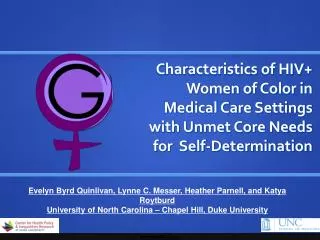
Characteristics of HIV+ Women of Color in Medical Care Settings with Unmet Core Needs for Self-Determination Evelyn Byrd Quinlivan, Lynne C. Messer, Heather Parnell, and Katya Roytburd University of North Carolina – Chapel Hill, Duke University
Presenter Disclosures Evelyn Byrd Quinlivan • The following personal financial relationships with commercial interests relevant to this presentation existed during the past 12 months No relationships to disclose
HIV and Women • 33% HIV + Maryland, Connecticut, New Jersey, Delaware, Virgin Is. • 25% of USA HIV population • AIDS rates are • 35 times higher for black women • 5 times higher for Latinas • 2 times higher for Native Americans freeclipart.com
HIV Women of Color Initiative • Special Project of National Significance, HRSA • Increase entry and retention in care • 11 sites in USA • 1 North Carolina site
Requirements to be “In Care” • Medical visits • Blood draws • Medication adherence • Coordination of resources • Sharing of personal story
MOTIVATION CONTINUUM(Ryan and Deci) • Amotivation: No intention • External:Compliance, External Rewards /Punishments • Introjected:Self control, Internal rewards/punishment • Identified:Personal Importance, Values • Integrated:Synthesis w/ self • Intrinsic:Interest, Enjoyment, Satisfaction
Self-Determined Behavior wikipedia
Guide to Healing • Nurse Guide • Systems Navigation • Education • Relationship building • Autonomy support womenshistory.about.com
Methods • 186 unique HIV+ WOC attending medical clinic • 99% were African- American. • Interviews: • Self-determination Needs • (Basic Psych Needs, in general) • Trauma • WHO Trauma Scale • Psychological Abuse • Index of Psychological abuse • Other items • Linear regression models for predictors of self-determination constructs.
Demographics 10% in Non-permanent Housing
Autonomy Scale Tier 1 N=17 b6 Baseiine
Relatedness Scale Tier 1 N=176 Baseline
Competency Scale Tier 1 N=176 Baseline
Trauma Tier 1 N=176 Baseline
Autonomy & Low Education. Tier 1+2 N=189 (Baseline)
Adult trauma does not alter autonomy. Tier 1+2 N=189 (Baseline)
Child trauma & autonomy. Erased by demographics and psychological abuse. Tier 1+2 N=189 (Baseline)
Psychological Abuse & Reduced Autonomy. Tier 1+2 N=189 (Baseline)
Relatedness & low education, unemployment. Tier 1+2 N=189 (Baseline)
Adult trauma & relatedness Assoc. erased by child trauma. Tier 1+2 N=189 (Baseline)
Child trauma & reduced relatedness. Tier 1+2 N=189 (Baseline)
Psychological Abuse, no effects seen. Tier 1+2 N=189 (Baseline)
Competency, education, unemployment. Tier 1+2 N=189 (Baseline)
Adult trauma, erased by child trauma. Tier 1+2 N=189 (Baseline)
Child trauma erased by adult trauma. Tier 1+2 N=189 (Baseline)
Psychological Abuse , Competency Tier 1+2 N=189 (Baseline)
Summary • Low Autonomy, Relatedness, Competency are expressed by HIV+ women of color. • Less than HS<=> Autonomy, Relatedness, Competency. • Not working <=> Relatedness. • Adult trauma <=> no independent effect • Child trauma <=> lowered Relatedness • Psychological Abuse <=> low Autonomy and Competence
Cons and Pros • Women in clinic • Associations are seen; can not conclude causality • African-American population, can not make conclusions about other populations • 189 / 380 women • Standard instruments used • Diversity in age, education
Conclusions • Addressing self-determination needs may promote • Retention-in care • Adherence to medication • Engagement in healthy living • Future directions: • Clinical assessment tools • Intervention tools
Acknowledgements • Ryan White Program SPNS program (HA15148) • Center for AIDS Research (P30-A150410). • Clinic staff advisors • Lynda Bell, NP, Natasha Bowditch, LCSW, Jonah Pierce, RN • Collaborations • AdaAdimora • Data Management • Donna Safely, Sammy Tcwhenko, Darren Weber, Kim Walker • Interviewers • Randi Gordan, DeaPapjorgii, Nancy DeSousa, Jenn Huff, Mary Key • Patients who share their stories with courage.