Exploring Nature: Monthly Journaling Activities for Observing Ecosystems
This series of monthly journaling assignments engages students in observing and recording changes in their local ecosystems. From quiet "Sit and Listen" observations to "Sit and Watch" reflections, each month focuses on different aspects of nature, such as plant life, animal behavior, and environmental conditions. Students will collect soil and water samples, create bark rubbings, and track animal evidence, fostering a deeper understanding of their surroundings while encouraging detailed documentation of their observations throughout the year.

Exploring Nature: Monthly Journaling Activities for Observing Ecosystems
E N D
Presentation Transcript
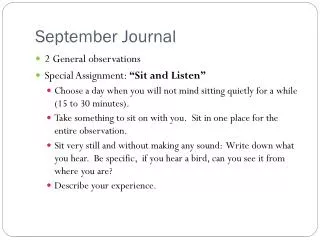
September Journal • 2 General observations • Special Assignment: “Sit and Listen” • Choose a day when you will not mind sitting quietly for a while (15 to 30 minutes). • Take something to sit on with you. Sit in one place for the entire observation. • Sit very still and without making any sound: Write down what you hear. Be specific, if you hear a bird, can you see it from where you are? • Describe your experience.
October Journal • 2 observations • General Observation: Be sure to note changes that have occurred related to plant life, trees, and animals you can see and hear • Water Sample: • Completed in class. • Sample must be brought in before lab day.
November Journal • 2 observations • General Observation: Be sure to note changes that have occurred related to plant life, trees, and animals you can see and hear • “Sit an Watch”: • Allow 15 minutes to sit and watch your area. • Stay in the same place the entire time; try not to move too much and watch. • What did you see? • Describe your experience.
December • 2 General Observations • Soil sample: • Collect a soil sample from your ecosystem. • Sign out and use the soil sample tool to collect a sample of soil.
January • 2 observations • Rub A Dub Tree: • Take 3 different Bark Rubbings. • Paste these into your journal • Identify the kinds of trees that are in your area of study. Common and Scientific Name. • Identify the characteristics you used to ID your tree. Be as specific as you can be. • Cite your sources
February • 2 observations • Be a Tracker: • Include a picture or sketch (with scale) of 3 types of animal evidence. • Identify the type of animal by common and scientific name. • Record the clues that led you to ID the organism. • Cite Sources for each • Include a reflection as to what the organism was doing/where they were going/how many of the organisms where there…
March • 2 observations • Ecosystem Disaster:Design a chart that organizes the following information. Consider this: • Location of your ecosystem • Surrounding area (research what these words mean before you begin) • Topography • Vegetation • Civilization (buildings, roads, farm land, etcetera) • Realistic potential disasters that would affect your ecosystem • Preventive measure possible
April • 2 observations • “Sit an Watch”: • Allow 15 minutes to sit and watch your area. • Stay in the same place the entire time; try not to move too much and watch. • What did you see? • Describe your experience. • Compare it to your first Sit and Watch (November) • I expect A LOT of DETAIL!!
May • 2 observations • Water Sample #2 • Completed in class. • Sample must be brought in before lab day.
June Journal • Ecosystem Conclusion