Overview of Regulatory Aspects for Nanomaterials in Food Safety and Risk Management
40 likes | 144 Vues
This document provides a comprehensive analysis of the regulatory landscape governing nanomaterials (NMs) in food across major global markets, including the EU, the US, Canada, Japan, and Australia/New Zealand. It addresses the distinctions between nano and non-nano substances, defines terms like food additives and dietary supplements, and emphasizes the need for specific methods in risk assessment and safety evaluations. Additionally, the document discusses existing guidance on NM detection in food contact materials and offers insights into best practices, while ensuring existing frameworks are respected and critical evaluation principles are maintained.


Overview of Regulatory Aspects for Nanomaterials in Food Safety and Risk Management
E N D
Presentation Transcript
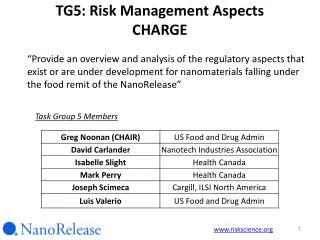
TG5: Risk Management Aspects CHARGE “Provide an overview and analysis of the regulatory aspects that exist or are under development for nanomaterials falling under the food remit of the NanoRelease” Task Group 5 Members www.riskscience.org
TG5: Risk Management Aspects (Charge) Describe current regulatory context for NMs to be used in food in global markets. (Status) We don’t have every country, but we have major markets with specific nano-foods regulation • Australia/New Zealand (trying to recruit volunteer) • Canada • European Union • Japan • United States (Status) Will include definitions (food additive etc.) and what is considered food/dietary supplement. (Charge) Discuss distinctions (nano vs. not nano) and overview of definitions. (Status)Overview of definitions/working principles/points to consider. (Status) ILSI NanoRelease does not have and will not recommend a definition. (Status) Critical to highlight where a “definition” may require development of a method. www.riskscience.org
TG5: Risk Management Aspects (Charge) Provide overview of available safety and risk assessment guidance/documents. (Status) Includes previous guidance/regulation and nano-specific guidance/regulation. (Status) Discussion of specific requirements that create need for a method (e.g size number distribution). (Status) Discussion of decision points/results that guide testing requirements. (Charge) Describe currently used regulatory requirements and guidance available for detection of migration from food contact materials. (Status) Includes previous guidance/regulation and nano-specific guidance/regulation. (Status) Discussion of specific requirements that create need for a method (e.gcharacterization of nanomaterial in food contact). (Status) Discussion of decision points/results that guide testing requirements (e.g what if no migration?). www.riskscience.org
TG5: Risk Management Aspects Analysis • Compare/Contrast Legislation • Careful not to criticize, but perhaps point out “best practices” in certain approaches. • Cannot offer recommendations for changes, this could be interpreted as “new guidance”. • Should link discussion back to METHODS ( i.e. what method is necessary to satisfy a specific regulatory requirement). • Case Studies • Describe evaluation of a particular nanomaterial in each regulatory framework. • Possibly use case studies devised by Woodrow Wilson PEN. • For TG5 members from government, this approach must not pre-judge a nanomaterial. • “Nice to know” versus “Need to know” • Are there certain characteristics that will be required, while others might be beneficial, but not critical. • Concern from TG5 Members too many permeations to be useful. • Flow Diagram/Decision Tree www.riskscience.org