6.1 The Polygon Angle-Sum Theorem
50 likes | 194 Vues
The Polygon Angle-Sum Theorem states that the sum of the interior angles of an n-gon is (n-2)×180°. This theorem helps us calculate the interior angles of polygons, such as heptagons. Polygons can be classified into equilateral ones, with all sides equal, and equiangular ones, with all angles equal. A regular polygon possesses both properties. Additionally, the Exterior Angle-Sum Theorem states that the sum of the exterior angles of any polygon is always 360°, regardless of the number of sides.


6.1 The Polygon Angle-Sum Theorem
E N D
Presentation Transcript
6.1 The Polygon Angle-Sum Theorem Boyd/Usilton
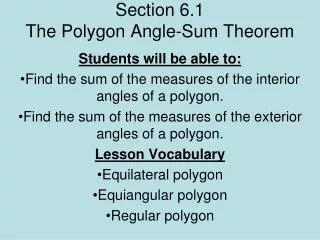
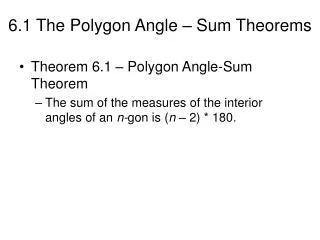
Theorem 6-1 Polygon Angle-Sum Theorem • The sum of the measures of interior angles of an n-gon is (n-2)180. n= # of sides • What is the sum of the interior angles of a heptagon?
Polygons • Equilateral: A polygon with all sides congruent. • Equiangular: A polygon with all angles congruent. • Regular polygon: A polygon that is both equilateral and equiangular.
Corollary to the Polygon Angle-Sum Theorem • The measure of each interior angle of a regular n-gon is (n-2)180 n
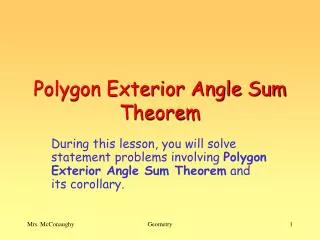
Theorem 6-2 Polygon Exterior Angle-Sum Theorem • The sum of the measures of the exterior angles of a polygon, one at each vertex, is 360. For pentagon, m<1 + m<2 +m<3 +m<4 +m<5=360