The Polygon Angle Sum Theorems
A polygon is a closed plane figure with at least three sides, where sides intersect only at endpoints and no adjacent sides are collinear. To name a polygon, the vertices are listed in order. Polygons can be classified as convex or concave. A diagonal connects two vertices of a polygon. A convex polygon has no diagonals that extend outside it, while a concave polygon has at least one diagonal that does. Understanding these classifications is essential for geometric applications and theorems related to polygons.

The Polygon Angle Sum Theorems
E N D
Presentation Transcript
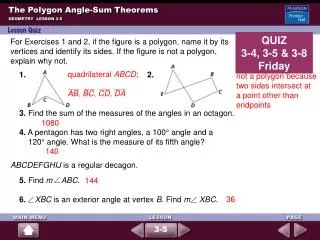
Polygon • A polygon is a plane closed figure with at least three sides. The sides intersect only at their endpoints, and no adjacent sides are collinear.
Naming a Polygon • When naming a polygon, you name the vertices in order.
Convex vs. Concave • Diagonal – a line segment connecting two vertices of a polygon • Convex Polygon – has no diagonal with points outside the polygon • Concave Polygon – has at least one diagonal with points outside of the polygon