
SlideServe
Menu
Préférences
© SlideServe · v2026

Run Selenium tests from Continuous Integration tools

laymanlearning avatar
3 diapositives · 282 Views · Sep 18, 2015

Selenium a Web based automation tool that automates anything and everything available on a Web page. http://laymanlearning.com/selenium-training/ --- Send Enquiry --- hr@laymanlearning.com
Run Selenium tests from Continuous Integration tools - slide 1
01 / 3Run Selenium tests from Continuous Integration tools
1 / 17

Télécharger la présentation

Run Selenium tests from Continuous Integration tools
Une image / un lien ci-dessous est fourni (tel quel) pour télécharger la présentation

Politique de téléchargement : le contenu du site vous est fourni TEL QUEL pour votre information et votre usage personnel ; il ne peut être vendu, concédé sous licence ni partagé sur d’autres sites sans l’accord de son auteur.Le contenu vous est fourni TEL QUEL, pour votre information et votre usage personnel uniquement. Téléchargez la présentation en cliquant sur ce lien. Lors du téléchargement, si vous ne parvenez pas à télécharger une présentation, l’éditeur a peut-être supprimé le fichier de son serveur.Pendant le téléchargement, si vous ne parvenez pas à obtenir une présentation, le fichier a peut-être été supprimé par l’éditeur.

F I N

Plus de contenu associé

Transcription de la présentation
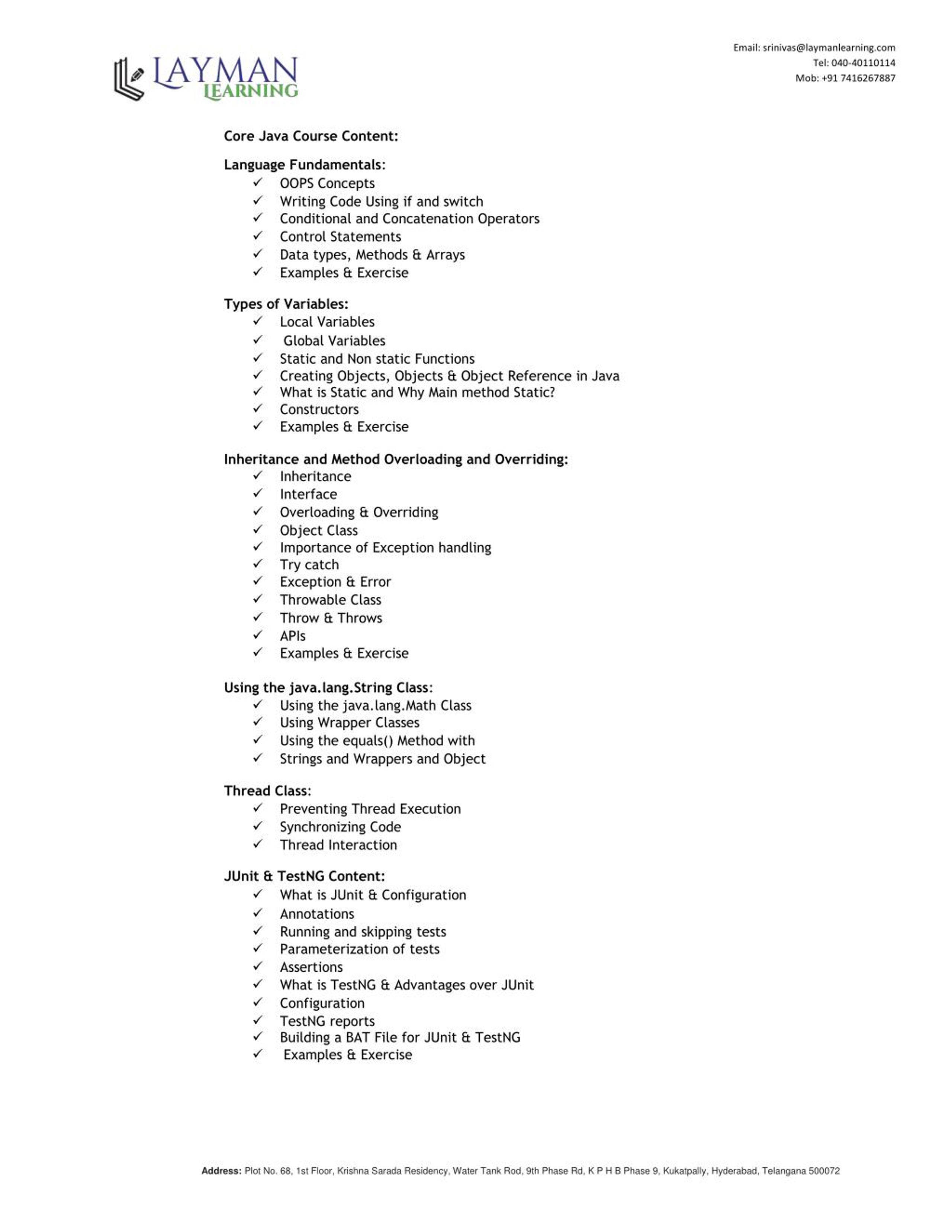
  1. Email: srinivas@laymanlearning.com Tel: 040-40110114 Mob: +91 7416267887 Core Java Course Content: Language Fundamentals:  OOPS Concepts   Writing Code Using if and switch   Conditional and Concatenation Operators  Control Statements   Data types, Methods & Arrays  Examples & Exercise  Types of Variables:  Local Variables  Global Variables   Static and Non static Functions   Creating Objects, Objects & Object Reference in Java   What is Static and Why Main method Static?  Constructors   Examples & Exercise  Inheritance and Method Overloading and Overriding:  Inheritance  Interface  Overloading & Overriding   Object Class   Importance of Exception handling   Try catch   Exception & Error  Throwable Class   Throw & Throws  APIs   Examples & Exercise   Using the java.lang.String Class:  Using the java.lang.Math Class  Using Wrapper Classes  Using the equals() Method with   Strings and Wrappers and Object  Thread Class:    Preventing Thread Execution  Synchronizing Code  Thread Interaction  JUnit & TestNG Content:  What is JUnit & Configuration   Annotations   Running and skipping tests   Parameterization of tests  Assertions   What is TestNG & Advantages over JUnit  Configuration   TestNG reports   Building a BAT File for JUnit & TestNG  Examples & Exercise    Address: Plot No. 68, 1st Floor, Krishna Sarada Residency, Water Tank Rod, 9th Phase Rd, K P H B Phase 9, Kukatpally, Hyderabad, Telangana 500072

  2. Email: srinivas@laymanlearning.com Tel: 040-40110114 Mob: +91 7416267887   Selenium Course: Introduction to selenium:  What is Selenium?   What is the use of selenium?   When selenium can be useful in testing.   Features of Selenium.   What is the difference between Selenium and QTP and SilkTest?  Selenium Components & Installations:  Selenium IDE.   Selenium RC (selenium 1.0).  Web Driver (Selenium 2.0).  Selenium Grid.  Object Identifications:  Installation of Firebug and Xpath Checker.   Ways of object Identifications using different browsers.  XPath optimal ways.   Object Identification using CSS.   Differences between XPath and CSS.   Creating Environment for Selenium 2.0 and WebDriver:  Installation of Eclipse.   TestNG configuration for Eclipse.  Creating the generic scripts in selenium.  Creating the scripts by using functions.   Running the scripts in Eclipse.  Explain about Webdriver with examples.   Browser commands with examples.  Interactive commands with examples.   Information commands with examples.  Validation commands with examples.   Explain difference between Selenium RC and Webdriver.   Examples & Exercise for Webdriver  Handling Windows and Web tables: Concept of window id & extracting window id with selenium object reference  Handling pop ups Handling web tables  Handling Frames. Examples & Exercise Assertions (Validations and Verifications):  What is Validation?   What is the use of validations in Automation testing?   When we use validations in Real-timeproject.   What are the Difference between Assertions and Verifications?  How to use Validations.       Frameworks:     What is Framework? Types of Frameworks.  What is modular framework? What is Data Driven framework?  Address: Plot No. 68, 1st Floor, Krishna Sarada Residency, Water Tank Rod, 9th Phase Rd, K P H B Phase 9, Kukatpally, Hyderabad, Telangana 500072

  3. Email: srinivas@laymanlearning.com Tel: 040-40110114 Mob: +91 7416267887 What is Keyword driven framework?  What is Hybrid framework?  Use of Framework.   Explain me about your framework.  How to develop the framework.   Integration of the framework.   How to execute the scripts from framework.    Selenium Grid Course Content: Ant & Selenium Grid Configuration:  Configuring Ant   Building xml configuration (Single & Parallel Execution)   HTML report generation using Ant   Building a BAT file   Examples & Exercise   Creation of frameworks using Selenium with Java (Using TestNG):  Explain about page object repository   Maintaining object repository using flat files (.Properties)  Maintaining object repository using excel files (.xls)  Maintaining object repository using Constructors (.Java)  Third Party tools:  Sauce Labs and Jenkins.   Address: Plot No. 68, 1st Floor, Krishna Sarada Residency, Water Tank Rod, 9th Phase Rd, K P H B Phase 9, Kukatpally, Hyderabad, Telangana 500072