Download
1 / 17
170 likes | 275 Vues
This piece examines the history and development of gaming from its inception with "Tennis for Two" in 1958 to contemporary titles like "Virtua Tennis 3." It highlights key elements of engaging game design, such as graphics improvements, adaptive opponents, and social interactions, as well as the rise of serious games in training and healthcare. Emphasizing the importance of storytelling, simulation, and feedback in gaming, the article discusses current and future trends including virtual worlds, automatic content creation, and personalized gaming experiences.

E N D
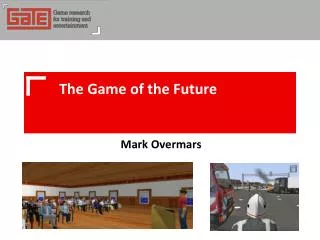
The Game of the Future Mark Overmars
The First Computer Game • 1958 Brookhave National Laboratory • Tennis for Two
Anno 2008 Virtua Tennis 3 (PS3) Tennis on Wii
Spot the Differences • Better graphics • Adaptive computer opponents • Storyline/setting • Internet play • Interface
Ingredients of a Game • Storyline • Gives global motivation • Discovery, surprise, emotion • Game play • Rules, challenges, rewards • Leads to continued interest • Simulation • Gives feedback on decisions and actions • (Does not need to be realistic) • Social elements • Collaborate and help each other • In a good games these elements are in balance
Frustration challenges FLOW Boring abilities Why use Games • Games give motivation • Storyline, challenges, rewards • Games can adapt to the abilities of the players • Reduces frustration and boredom • FLOW
Why use Games • Games give direct feedback on decisions and actions • Through simulation • Better learning process • Better insight in consequences • Games can be played always and everywhere • Use of lost hours • Use at home • As a consequence more time is spend on the learning process • Players help each other • Inside and outside the game
Uses of Serious Games • To train the use of equipment • Flight simulators • Drive simulators • Simendo (endoscopy) • To train procedures (in particular the strategic level) • Safety training, … • Learning facts and abilities • Language and calculus • Entrepreneurship • ...
Uses of Serious Games • To stimulate certain behavior • Remission, GlucoBoy • Political games • To get insight in processes • Social, communication • Inside companies • To distract people • Pain reduction for burnings • Snow World
Uses of Serious Games • To keep people in contact • Patients • Elderly • Marketing • America’s Army • Operation Ibiza, Pool Paradise • Many other applications • Rehabilitation • Virtual tourism • ...
Current and Future Trends • Automatic Content Creation • Virtual Worlds • Characters and behavior • Scenarios • Realism • Graphics • Animations • Behavior
Current and Future Trends • Adaptive game play • Observe the player • Create a dynamic player model • Adapt the game play • More personalized experience • “Pleasurable Frustration” • Physical and other interaction • Dance Dance Revolution, Wii • Brain-Machine interfaces
Current and Future Trends • Location-based gaming • Using devices with GPS • Location plays an important role in the game play • User generated content • Levels, characters, worlds (Second Life) • Challenges, scenarios • Complete Games • www.yoyogames.com
Utrecht: AGS and GATE and … • Center for Advanced Gaming and Simulation • Utrecht University, TNO, Utrecht School of the Arts • Virtual organization with a center in Utrecht • About 80 researchers • Multidisciplinary • GATE project • 19 MEuro project • Research, Knowledge transfer, Pilots • Muse • Dutch Game Garden • Festival of Games • Expertise Center
Final Remarks • Games form an important element of our lives • Influence and impact will increase further • Serious games will have a huge effect on • How we learn • How we communicate • Healthcare • How we live • The future leads to new possibilities that are hard to imagine • Control through body and brain • Mixed reality in which the real and virtual world blend • Student centered learning • The world in our hands • … • It is only the beginning …
Thank You • Contact Mark Overmars markov@cs.uu.nl mark@yoyogames.com http://www.yoyogames.com http://gate.gameresearch.nl http://www.cs.uu.nl