Understanding Ocean Floor Mapping through Echosounding and SONAR Technology
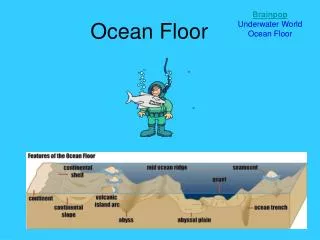
Echosounding is an indirect method used to map the ocean floor by transmitting sound waves from the surface. These sound waves travel to the ocean floor, reflect back, and the time taken for the round trip is recorded. Oceanographers can determine the depth using the formula: Ocean Depth = (number of seconds/2) x 1500 m/s. For instance, if sound takes 15 seconds to return, the ocean depth is calculated as 11,250 meters. The ocean floor features various terrains, including continental shelves, slopes, abyssal plains, and mid-ocean ridges.

Understanding Ocean Floor Mapping through Echosounding and SONAR Technology
E N D
Presentation Transcript
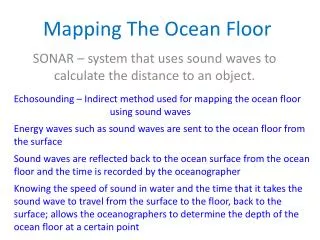
Mapping The Ocean Floor • Echosounding – Indirect method used for mapping the ocean floor using sound waves • Energy waves such as sound waves are sent to the ocean floor from the surface • Sound waves are reflected back to the ocean surface from the ocean floor and the time is recorded by the oceanographer • Knowing the speed of sound in water and the time that it takes the sound wave to travel from the surface to the floor, back to the surface; allows the oceanographers to determine the depth of the ocean floor at a certain point SONAR – system that uses sound waves to calculate the distance to an object.
Ocean Depth = (# of seconds / 2) X 1500 m/s How deep is the ocean floor if it takes the sound wave 15 seconds to return to the boat? Step 1 – Write the equation Ocean Depth = (# of seconds / 2) X 1500 m/s Step 2 – Substitution OD = (15 seconds / 2) X 1500 m/s Step 3 – Answer with units 11,250 meters (m)
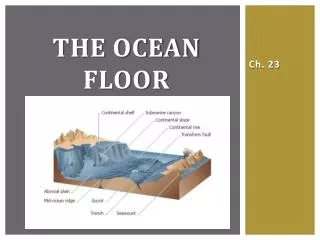
Ocean Floor There are many ocean floor features: • Continental Shelves • Continental Slopes • Continental Rises • Abyssal Plains and Hills • Seamounts • Guyots • Mid-Ocean Ridges • Trenches and Submarine Canyons • Rift Valleys