
SlideServe
Menu
Préférences
© SlideServe · v2026

Intelligence: IQ Testing & Theories

lcenter avatar
13 diapositives · 217 Views · Jan 06, 2020

Explore different views on intelligence, including IQ testing, emotional intelligence, Gardner's Multiple Intelligence Theory, and the Two-Factor Theory. Learn about intelligence scores, nature vs. nurture debate, and cultural biases in testing.
Intelligence: IQ Testing & Theories - slide 1
01 / 13Intelligence: IQ Testing & Theories
1 / 17

Télécharger la présentation

Intelligence: IQ Testing & Theories
Une image / un lien ci-dessous est fourni (tel quel) pour télécharger la présentation

Politique de téléchargement : le contenu du site vous est fourni TEL QUEL pour votre information et votre usage personnel ; il ne peut être vendu, concédé sous licence ni partagé sur d’autres sites sans l’accord de son auteur.Le contenu vous est fourni TEL QUEL, pour votre information et votre usage personnel uniquement. Téléchargez la présentation en cliquant sur ce lien. Lors du téléchargement, si vous ne parvenez pas à télécharger une présentation, l’éditeur a peut-être supprimé le fichier de son serveur.Pendant le téléchargement, si vous ne parvenez pas à obtenir une présentation, le fichier a peut-être été supprimé par l’éditeur.

F I N

Plus de contenu associé

Transcription de la présentation
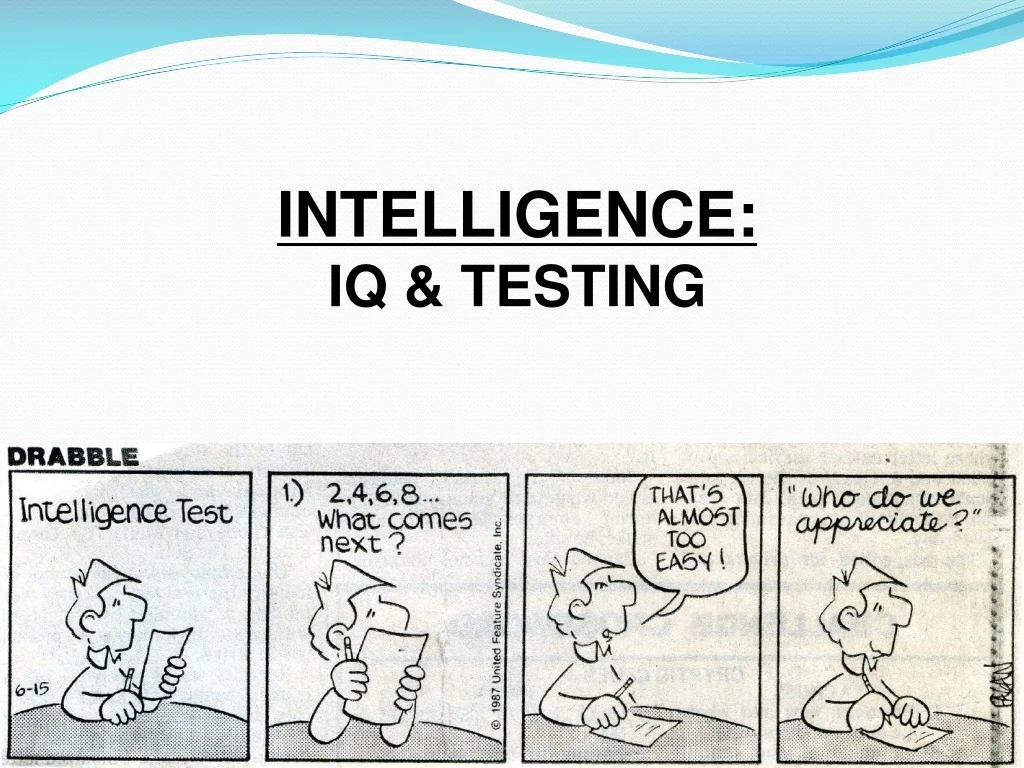
  1. INTELLIGENCE: IQ & TESTING

  2. INTELLIGENCE The ability to acquire new ideas and new behavior, and to adapt to new situations. Different views on Intelligence exist Emotional Intelligence:The ability to perceive, use, understand, and regulate emotions. Two-Factor Theory: Intelligence includes a general ability (g) level and specific mental abilities (s) Gardner’s Multiple Intelligence Theory: Numerous (8) and unrelated intelligences

  3. Standard Responses Sample Question: • The Mental Rotation Test Which two of the other circles contain a configuration of blocks identical to the one in the circle at the left?

  4. Sample WAIS Verbal tasks:

  5. INTELLIGENCE TEST Measure IQ, or a standardized measure of intelligence based on a scale of which 100 is average • Stanford-Binet Intelligence Scale: • Originally meant for children; adapted for adults • Groups test items by age level • 100 is average for given age • Wechsler Tests: • More common today • Three versions (2-6, 6-16, 16-89) • More detailed scoring

  6. IQ SCORES – What do they mean? Average score is 100 Traditionally 70 or below = mentally handicapped Good indicator of success in school Do not predict success in the real world Nature v. Nurture: Both genetic factors & the environment play a role in IQ. The % each contributes is debatable. Cultural Bias: wording used in questions may be more familiar to people or one social group than to another group

  7. Direct measurements of intelligence • Brain volume correlates moderately (0.44) with intelligence (head size does NOT). • Glucose consumption may correlate negatively (-0.58) with ability on cognitive tasks. • Speed at which one can perceive an image (+0.4) • Speed at which brain waves register a stimulus.

  8. Are There Multiple Intelligences? • Savant Syndrome • condition in which a person otherwise limited in mental ability has an exceptional specific skill • computation • drawing

  9. Are There Multiple Intelligences? • Social Intelligence • the know-how involved in comprehending social situations and managing oneself successfully • Emotional Intelligence • ability to perceive, express, understand, and regulate emotions

  10. Intelligence and Creativity • Creativity • the ability to produce novel and valuable ideas • expertise • imaginative thinking skills • intrinsic motivation • creative environment

  11. Howard Gardner and Multiple Intelligences