Jacksonian Poltics
Jacksonian Poltics. Preceded by the so-called Era of Good Feelings. Learning Objectives—Jacksonian Politics. Identify the impacts of the Jackson presidency. How did the Jackson presidency represent and create political transformation in the United States.

Jacksonian Poltics
E N D
Presentation Transcript
Jacksonian Poltics Preceded by the so-called Era of Good Feelings
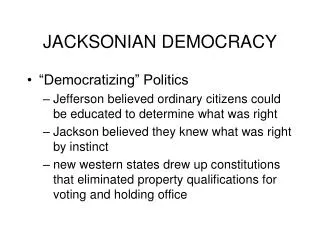
Learning Objectives—Jacksonian Politics • Identify the impacts of the Jackson presidency. • How did the Jackson presidency represent and create political transformation in the United States. • Look at democracy, the West, the scope and power of the national government, and the party system • How did Jackson affect the presidency?
James Monroe—Era of Good Feelings • Era of Good Feelings label comes from a single but important Good Will tour of New England in 1817 • Ran unopposed in 1820 and got all but 4 electoral votes • Great Cabinet: John Quincy Adams, William H. Crawford, John C. Calhoun http://faculty.adams.edu/~ercrowth/us202powerpoints/monroe.ppt#259,4,Adams, Crawford, & Calhoun
Election of 1824 • Candidates • The Tennessee legislature nominated Andrew Jackson • The Kentucky legislature nominated Henry Clay • Massachusetts nominated John Quincy Adams • The congressional caucus, nominated William H. Crawford . Andrew Jackson http://go.dbcc.edu/behavior_socsci/mckeowm/files/33A7092D1B814A209FA58BCF04AEAC36.ppt#265,10,V. Missouri Compromise
B. The Campaign • John C. Calhoun, ran for Vice-President on the Adams and Jackson tickets. • Adams benefited from the split of Southern and Western candidates. • Adams' supported Clay’s "American System“. • Jackson attacked "King Caucus ," supporting the right of the people to choose their own President. John C Calhoun http://go.dbcc.edu/behavior_socsci/mckeowm/files/33A7092D1B814A209FA58BCF04AEAC36.ppt#265,10,V. Missouri Compromise
C. The Results • Jackson received 99 electoral votes, Adams 84, Crawford 41, Clay 37. The election was settled in the House of Representatives. • Clay convinced The state delegation of Kentucky to vote for Adams. • Corrupt Bargain: Clay with making a "corrupt bargain“. • Adams offered Clay the position of Secretary of State. • the Republican party divided into two factions: National Republicansand Democratic Republicans . Clay’s appointment to Secretary of State. http://go.dbcc.edu/behavior_socsci/mckeowm/files/33A7092D1B814A209FA58BCF04AEAC36.ppt#265,10,V. Missouri Compromise
http://content.answers.com/main/content/wp/en/thumb/3/3c/350px-ElectoralCollege1824-Large.pnghttp://content.answers.com/main/content/wp/en/thumb/3/3c/350px-ElectoralCollege1824-Large.png
Election of 1824 http://www.acsu.buffalo.edu/~msaghir/MR%20Folder%202
the Election of 1828 • the abominable tariff
The Age of Jackson • Andrew Jackson was elected in 1828 and remained in office for two terms, until 1836. • Jackson was known as a national hero, and the symbol for the "common man". • Jackson also had a strong-will & quick temper. • Jackson’s Presidency is known for: • Jacksonian democracy • Nullification issue • National bank issue http://www.burke.k12.nc.us/ebhs/academics/socialstudies
The Age of Jackson http://www.burke.k12.nc.us/ebhs/academics/socialstudies
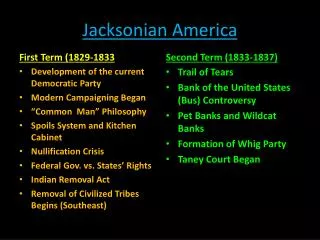
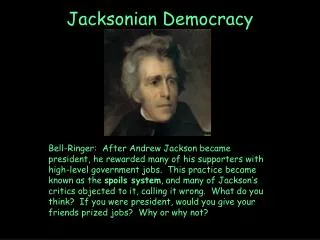
Jacksonian Democracy • Strengthened the executive branch & the Presidency at the expense of Congress • Broaden public participation in government. • Enfranchised all eligible white males, rather than just property owners (White male suffrage) • Supported the patronage system • Favored elected judges.. • Favored geographical expansion, sometimes justifying it in terms of Manifest Destiny http://www.burke.k12.nc.us/ebhs/academics/socialstudies
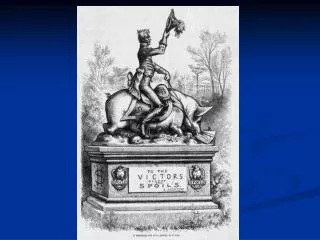
The Spoils System • Also known as Political Patronage • The patronage system enabled politicians to appoint their supporters into Gov’t jobs, • Jacksonian’s argued that these appointments would lead to increased public participation in politics. http://www.burke.k12.nc.us/ebhs/academics/socialstudies
democracy in America • the expanded franchise
Jacksonian Democracy • JACKSONIAN ERA 1824 - 1840 • JACKSON 1828-1836 • Jackson - the people's man • vigorous leadership • egalitarian • any honest citizen can represent in government • the people themselves should decide on public policy • "spoils system" • offices given as a reward for their support POPULAR WILL -----> PUBLIC POLICY The Election of 1828 http://faculty.sierracollege.edu/ccox/history_17A/15%20Building%20A%20Nation.ppt#301,7,BUILDING A NATION
Nullification Issue • A sectional crisis during the Jackson’s presidency over the question of a state’s right to nullify a federal law • The issue developed around protective tariffs, specifically the Tariff of 1828, that was also called the "Tariff of Abominations". • The debate over states' rights threatened conflict between South Carolina and the federal government http://www.burke.k12.nc.us/ebhs/academics/socialstudies
John C. Calhoun • From South Carolina and Jackson’s VP in his first term, • Calhoun believed in strong states rights in contrast to a strong central government • He led the southern fight against high Protective Tariffs • Near death in 1860, he led he south to secession http://www.burke.k12.nc.us/ebhs/academics/socialstudies
John C. Calhoun http://www.burke.k12.nc.us/ebhs/academics/socialstudies
South Carolina Exposition and Protest • Calhoun’s issues with the Tariffs were intense • He felt states had the right to Nullify laws of the Federal Gov't that were unconstitutional. • He further reasoned that if the federal Gov't refused to allow nullification, then states, could withdraw from the union. • Calhoun wrote down his theory in a document entitled The South Carolina Exposition http://www.burke.k12.nc.us/ebhs/academics/socialstudies
South Carolina Nullification Crisis • The Ordinance of Nullification declared both the tariffs of 1828 and 1832 null and void within SC state borders • In response, President Andrew Jackson sent naval vessels to Charleston • Congress passed a "Force Bill" authorizing Jackson to take actions to enforce law. • Henry Clay, the Great Compromiser, resolved the crisis with his Tariff of 1833, also know as the compromise Tariff http://www.burke.k12.nc.us/ebhs/academics/socialstudies
National Bank Issue • Andrew Jackson was opposed to the National Bank, even though it was declared constitutional by the supreme court in McCulloch v. Maryland, 1819 • Jackson's independent personality contributed to his efforts to undermine it • Finally, Jackson favored his Pet Banks • This caused the Panic of 1837 http://www.burke.k12.nc.us/ebhs/academics/socialstudies
National Bank Issue http://www.burke.k12.nc.us/ebhs/academics/socialstudies
Pet Banks • In his effort to destroy the Bank of the U.S., Jackson refused to deposit federal money in the National Bank. • Instead, he used state banks that were loyal to his party. • These banks were called Pet Banks. http://www.burke.k12.nc.us/ebhs/academics/socialstudies
Panic of 1837 • The prosperity of the early 1830s was led by the construction of new canals railroads • The prosperity bubble burst in 1837 • Causes include the economic policies of President Jackson who favored currency in only gold or silver (Tight Money) and who terminated the National Bank. • Also, Pres. Van Buren refused to involve the government in the economic recovery http://www.burke.k12.nc.us/ebhs/academics/socialstudies
Election of 1832 • President Andrew Jackson, candidate of the Democratic Party, easily won reelection against Henry Clay of Kentucky. • The first national election for Martin Van Buren of NY, who replaced Calhoun as VP http://www.burke.k12.nc.us/ebhs/academics/socialstudies
INDIAN REMOVAL ACT - 1830 • Congress, with Jackson’s support, passed the Indian Removal Act in 1830 • Under this law, the federal government funded treaties that forced tribes west • The Cherokee Tribe in Georgia refused and were supported by the Supreme Court • Jackson refused to abide by the Court decision • Jackson said, “John Marshall (Supreme Court Chief Justice) has made his decision, now let him enforce it.” • Trail of Tears followed the Court ruling as U.S. troops rounded up the Cherokee and drove them west, mostly on foot. . .thousands died http://webzoom.freewebs.com/centralhistory/A%20C%203%20US%20CHAPTER%203.ppt
INDIAN REMOVAL - 1830 http://webzoom.freewebs.com/centralhistory/A%20C%203%20US%20CHAPTER%203.ppt
Whig Party, 1832 to 1856 • The Whig party was formed in opposition to Andrew Jackson. • The name was based on American Whigs of 1770s who fought for independence. • Whig philosophy was compatible with the reformers goals. • The Whigs were commitment to Clay’s American System http://www.burke.k12.nc.us/ebhs/academics/socialstudies
Fuuuuuuuuumbllllllllllllle!!!!! • the handoff of the Presidency from Jackson to Van Buren
Election of 1836 • Winner: Martin Van Buren • As Andrew Jackson's Secretary of State and then Vice President, he helped built Jacksonian democracy • His Presidency was overshadowed by the economic hardship of the Panic of 1837. http://www.burke.k12.nc.us/ebhs/academics/socialstudies
http://content.answers.com/main/content/wp/en/thumb/d/d8/350px-ElectoralCollege1836-Large.pnghttp://content.answers.com/main/content/wp/en/thumb/d/d8/350px-ElectoralCollege1836-Large.png
Election of 1840 http://www.burke.k12.nc.us/ebhs/academics/socialstudies
Election of 1840 • Van Buren was not popular do to the 1837 depression • Harrison ran as a war hero and man of the people, while presenting Van Buren as a wealthy snob • Rallying under the slogan “Tippecanoe and Tyler, too,” the Whigs easily won • The 2-party system re-emerged http://www.burke.k12.nc.us/ebhs/academics/socialstudies