Download

1 / 18
240 likes | 418 Vues
This guide explores possessive adjectives in English and Spanish, highlighting how they indicate possession or relationships. In English, examples like "my dog" and "your house" illustrate usage, while Spanish counterparts such as "mi perro" and "tu casa" demonstrate the agreement in number with nouns. The text also explains context-based meanings for "su" and "sus" in Spanish, where possession is expressed without apostrophes, opting for "de + noun" instead. Essential for learners, this summary offers clarity on grammatical structures in both languages.

E N D
Possessive Adjectives • Adjectives DESCRIBE nouns, correct? • Well, they can also show possession.
Possessive Adjectivesin English my our Your your (plural) his, her, its their
English Examples ofPosessive Adjectives • my dog • your house • Her uncle • our Spanish class • Their friend
Here are the possessive adjectives in Spanish! Possessive adjectives show ownership or relationships between people. They are placed before the noun.
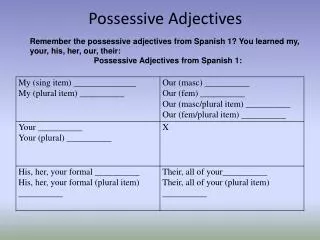
singular mi mis (my) tu tus (your) su sus (his,her, its, your) plural Nuestro(s) Nuestra (s) (our) Vuestro (s) Vuestra (s) (your) su sus (their, your) Spanish Possessive Adjectives
In English, the possessive adjectives his, her, and their tell whether something belongs to a male, a female, or more than one person. • In Spanish, the possessive adjective suhas many possible meanings (his, her, its, your, their). Context usually makes the meaning clear.
Possessive Adjectives • Some examples: mi hermano mis hermanos tu abuela tus abuelas su hijo sus hijos nuestro tío nuestros tíos nuestra tía nuestras tías
Agreement with Possessive Adjectives • The possessive adjective must be singular if the noun is singular and plural if the noun is plural.
More Examples of Posessive Adjectives • Mi prima es alta. • Todas mis primas son altas.
Possessive Adjectives Examples in Question Form • ¿Son rubios los hermanos de Rafael? • No, sus hermanos son pelirrojos.
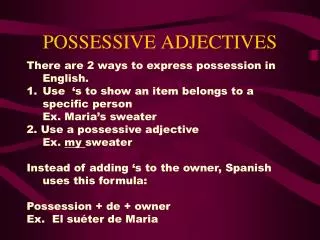
Showing Possession • In Spanish there are NO apostrophes. • You cannot say, for example, Jorge’s dog, (using an apostrophe)
Showing Possession You must say, “The dog of Jorge,” El perro de Jorge.
Review ofDe + noun • This concept of showing possession is using “de + noun.” For example:
De + Noun • Tengo el cuaderno de Felipe. • La hermana de María es amable.
Su and sus can take the place of a phrase with de + person. • ¿De dónde es la madre de Juan? • Su madre es de Puebla.
Your time in the Fun and Exciting World of Possessive Adjectives has come to an end.