
SlideServe
Menu
Préférences
© SlideServe · v2026

Historical background

lee-humphrey avatar
12 diapositives · 358 Views · Nov 15, 2014

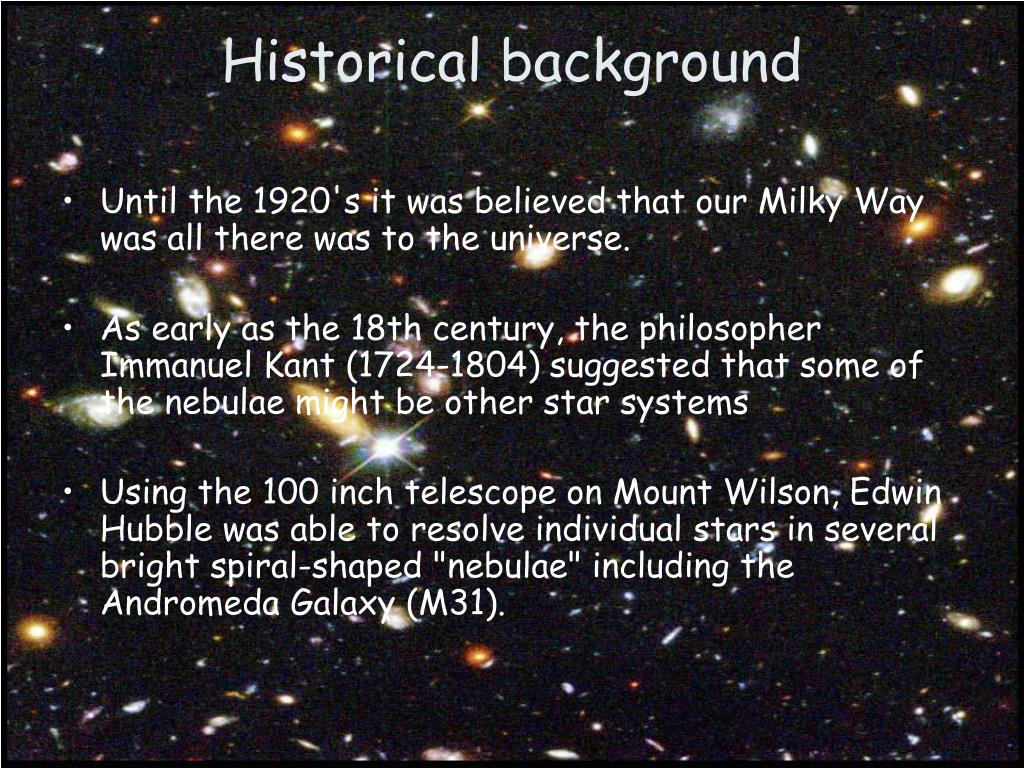
Historical background. Until the 1920's it was believed that our Milky Way was all there was to the universe. As early as the 18th century, the philosopher Immanuel Kant (1724-1804) suggested that some of the nebulae might be other star systems
Historical background - slide 1
01 / 12Historical background
1 / 17

Télécharger la présentation

Historical background
Une image / un lien ci-dessous est fourni (tel quel) pour télécharger la présentation

Politique de téléchargement : le contenu du site vous est fourni TEL QUEL pour votre information et votre usage personnel ; il ne peut être vendu, concédé sous licence ni partagé sur d’autres sites sans l’accord de son auteur.Le contenu vous est fourni TEL QUEL, pour votre information et votre usage personnel uniquement. Téléchargez la présentation en cliquant sur ce lien. Lors du téléchargement, si vous ne parvenez pas à télécharger une présentation, l’éditeur a peut-être supprimé le fichier de son serveur.Pendant le téléchargement, si vous ne parvenez pas à obtenir une présentation, le fichier a peut-être été supprimé par l’éditeur.

F I N

Plus de contenu associé

Transcription de la présentation
  1. Historical background • Until the 1920's it was believed that our Milky Way was all there was to the universe. • As early as the 18th century, the philosopher Immanuel Kant (1724-1804) suggested that some of the nebulae might be other star systems • Using the 100 inch telescope on Mount Wilson, Edwin Hubble was able to resolve individual stars in several bright spiral-shaped "nebulae" including the Andromeda Galaxy (M31).

  2. What is a galaxy ? • A galaxy is a large assembly of stars, gas, dust, and dark matter, held together by gravity. • Galaxies can be classified in several ways. The most common is a system developed by Edwin Hubble, which is based on the shape of galaxies.

  3. types of galaxies there are four main classes (as classified by Hubble) 1) Spiral galaxies • Disk + central bulge 2 ) A ‘subspecies’ of spiral galaxy is the class of barred spirals. • Disk + central bulge with bar

  4. 3) Elliptical galaxies • All bulge, elliptical shape, no disk; stars but little or no gas 4) Irregular galaxies • Irregular shape

  5. The class of spiral galaxies is further divided into classes Sa, Sb, & Sc. • Sa galaxies have big central bulges, tightly wound spiral arms, & relatively small amount of interstellar gas. • Sc Galaxies have small bulges, loosely wound spiral arms, & relatively large amount of gas. • Sb Galaxies are intermediate between Sa & Sc. • our own galaxy is an Sb galaxy, as is M31 & M51

  6. M31 Andromeda Galaxy (Sb type) M51 whirlpool galaxy (Sc type) M85 a ‘lenticular’ galaxy (on left) mostly bulge, a little disk (type S0) Sombrero galaxy (Sa type)

  7. M91 in Virgo Cluster (type SBb) M95 (type SBb)

  8. Elliptical galaxies contain very little gas and dust, and the gas that is present is very hot & diffuse. Consequently, there is no current star formation in elliptical galaxies. These galaxies are not disks, but flattened spheres called ellipsoids. Astronomers classify them as E0 for nearly spherical galaxies through E7 for very elongated ones. • The largest galaxies in the Universe are giant Ellipticals. They can contain trillion stars or more, and span as much as one million light years – about 10 times the diameter of the Milky Way.

  9. M60 giant elliptical galaxy in Virgo Cluster (on right) M32 dwarf elliptical galaxy, satellite of M31 M87 giant elliptical galaxy, the dominant Galaxy in Virgo Cluster

  10. Irregular galaxies have no obvious spiral or elliptical structure. • Irregular galaxies tend to contain lots of gasses and dust. NGC 1569 is a dwarf irregular galaxy Large Magellanic Cloud, best known irregular galaxy

  11. Astronomers also categorize galaxies by how much energy they produce in their cores. A particular class is called "active" galaxies, because they produce much more energy than "normal" galaxies. The most powerful active galaxies are quasars.

  12. Thank youuuuu so much ! ! ! 