Enhancing Data Management and Interoperability Standards for Global Observatories
This initiative focuses on defining best practices and international standards for data management and interoperability across data centers and observatories. Key activities include establishing working groups for data capture, quality control (QC) policies, and inventorying observatories' current and planned domains of observations, like in-situ time series and bio-samples. Collaboration with relevant organizations ensures comprehensive strategies for data distribution, visualization, and downloads, ultimately enhancing the utility and accessibility of environmental data for research and decision-making.

Enhancing Data Management and Interoperability Standards for Global Observatories
E N D
Presentation Transcript
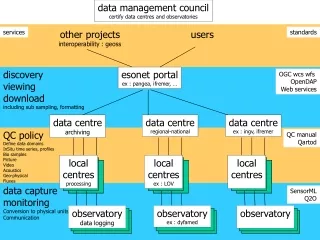
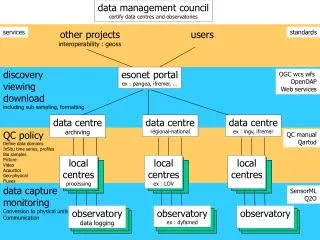
data management councilcertify data centres and observatories localcentres processing localcentres ex : LOV localcentres observatory ex : dyfamed observatory observatory data logging services other projects interoperability : geoss users standards discovery viewing download including sub sampling, formatting esonet portalex : pangea, ifremer, … OGC wcs wfs OpenDAP Web services data centre archiving data centre regional-national data centre ex : ingv, ifremer QC policy Define data domains InSitu time series, profiles Bio samples Picture Video Acoustics Geo-physical Fluxes QC manual Qartod data capture monitoring Conversion to physical units Communication SensorML Q2O
Action items • Create working groups on how to define best practicesand assess emerging standardsMake recommendations to the data management council • Data captureWork on standards and international best practicesSensorML, link with Qartod-Q2OInventory of observatories : current and plannedInventory of domain of observations (eg : InSitu time series, profiles, bio samples, picture, video, acoustics, geo-physical, fluxes…) • QC policyAdopt standards, vocabularies, ontologies • Archive, data distribution, interoperabilityLinks with Qartod-Q2ODiscovery, visualization, download • WE NEED PROPOSED PARTICIPANTS IN THESE 3 WORKING GROUPS
Data capture working group • Work on standards and international best practicesSensorML, link with Qartod-Q2OInventory of observatories : current and plannedInventory of domain of observations (eg : InSitu time series, profiles, bio samples, picture, video, acoustics, geo-physical, fluxes…) • Michael Diepenbroek, Thierry Carval (contact), Jaume Piera, Emre Damci, M. X (Loome), Maureen Pagnani, Stephane Pesant, Benoît Pirenne, Simon Jirka (to be confirmed)… • Related demonstration missions : LIDO, Momar, Marmara, Loome, EuroSites, Sesame
Quality control and quality assurance policy • Adopt standards, vocabularies, ontologies • Link with DEDALO (Etna hitec) ? • Link with MMI-Qartod - SeaDataNet (R. Lowry) and GEOSS, INSPIRE • Link with ITIS-APHIA for taxonomy, OBIS-Marbef, EUR-OCEANS • Members : T. Carval, Vladimiro Patatu, R. Lowry (?), John Graybeal, S. Pouliquen (as OceanSites), Janet Frederics (for Qartod), Maureen Pagnani (for EuroSites), Michael Diepenbroek, Stéphane Pesant • The scope is data and meta-data available from observatories and data centres • Certification of data centres, what are the criteria (?)
Archive, data distribution, interoperability on a data centres level • Links with Qartod-Q2ODiscovery, visualization, download • Michael Diepenbroek, Benoit Pirenne, Peter Baumann (OGC-WCS EarthLook), Rainer Schlitzer (ODV), Ruggero Nicotra, Jaume Piera • Analyse and comparison of standards (GSDI, OGC, OpenDAP, GRID, …) • What GMES services can we deliver ?
Task list • 1. G1 : obtain a contact person for each observatory (12 for the moment) • 2. G1, G2, G3 : inventory of relevant standards • 3. G1, G2, G3 : requirements collection (data types, use cases, metrics, citation) • 4. G1, G2, G3 : inventory of existing codes, software • 5. G1, G2, G3 : Specifications for Esonet reference architecture • 6. Implementation, evaluation on the 2 phases of demonstration missions • Preliminary schedule • 1 & 2 : end of April • 3 : online survey (subcontracted ?) Ingrid and Jaume, • 4 : online survey, June • 5 : fall 2008 • 6 : begining 2009
Glossary • GMES • INSPIRE
Global Ocean Observing System for ClimateGCOS Implementation Plan and JCOMM targets 2005-2006 57% 95% 40% 82% 80% 43% 72% 21% 48%