Understanding Biological Classification: The Binomial System and Its Importance
Discover the intriguing world of biological classification, introduced by Carolus Linnaeus. This system names organisms using a two-part structure, improving communication among scientists worldwide. Learn about the different levels of classification—Kingdom, Phylum, Class, Order, Family, Genus, and Species—through memorable mnemonics. Explore key plant and animal groups, including Bryophytes, Coniferophytes, and various invertebrate phyla. Understanding classification helps us recognize the relationships and similarities among species, fostering knowledge of our biological diversity.

Understanding Biological Classification: The Binomial System and Its Importance
E N D
Presentation Transcript
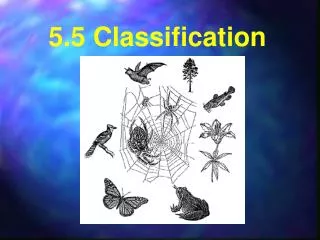
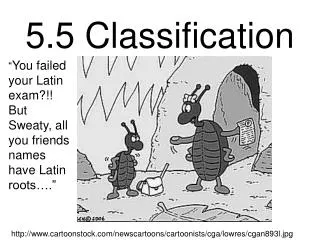
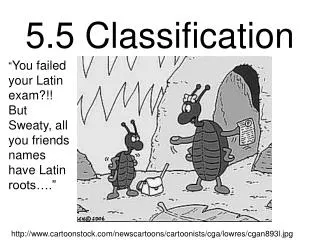
5.5 Classification “You failed your Latin exam?!! But Sweaty, all you friends names have Latin roots….” http://www.cartoonstock.com/newscartoons/cartoonists/cga/lowres/cgan893l.jpg
5.5.1 Why Classify? • The classification system we use was invented by Carolus Linneus (1707-1778) • It is called the Binomial system because all organisms are given 2 names – their Genus name and their species name. e.g Homo sapiens, (man), Mytilus edulis (common mussel)
Mytilus edulis Homo sapiens? http://www.marlin.ac.uk/imgs/Species/Mollusca/o_Mytedu.jpg
It is important that when scientists in Mongolia work on a species, a scientist in Brazil knows which one. Anemone Anemone http://www.sydneyaquarium.com.au/Downloads/INT/Wallpaper_1024x768_WaratahAnemone.jpg http://www.nmessences.com/healing_images/anemone_white_b1.jpg
It allows us to group similar organisms http://www.tigertouch.org/images/cats/lion.jpg http://www.felinest.com/images/bengal-tiger.jpg http://www.no-pest.com/MountainLion6.jpg http://i1.treknature.com/photos/6688/imgp1500a1a-copy1.jpg http://media.photobucket.com/image/genus%20felidae/crowskyler/animania/clouded_leopard3.jpg
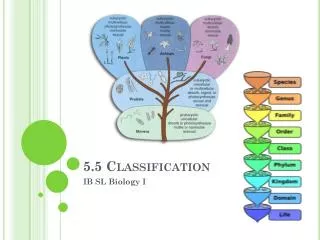
5.5.2 There are 7 levels of Classification: Kingdom Phylum Class Order Family Genus Species Make up a pneumonic to remember this list in order. King Philip Comes Over For Great Sausages. Activity: Classify Humans and one plant completely .
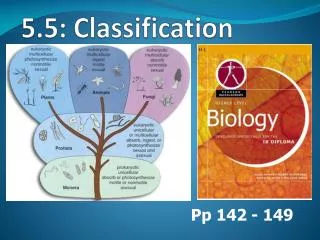
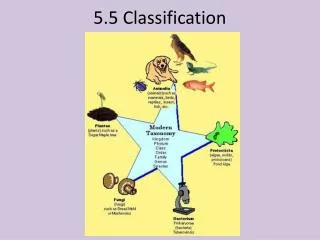
The 5 Kingdoms No cell walls Cellulose cell walls Chitin cell walls Many types of cell wall NAG-NAMA cell walls Multi-cellular Multi-cellular Single cellular Single + Multi-cellular Single cellular Many feeding types Many feeding types Photo-autotroph Saprotroph Heterotroph
5.5.3 A closer look at Plants: There are 4 phyla: • Bryophyte – The mosses • Filicinophyte – The Ferns • Coniferophyte – The Conifers • Angiospermophyte – The flowers
Bryophytes – The mosses • Simple non, vascular (no xylem and phloem.) no proper roots but have rhizoids, reproduce with spores. Male gamete swims to female! http://www.dcr.virginia.gov/natural_heritage/images/TIa_photo1_500.JPG http://www.anbg.gov.au/bryophyte/photos-800/grrimmia-sp-exposed-rock-WA.jpg
Filicinophytes – the ferns • Has stems roots and leaves. Reproduces by spores. Male gamete swims to female. http://www.centralfloridafarms.com/fern-vine/foxtail-ferndrm-web.jpg http://farm1.static.flickr.com/205/519433609_f1a29201d7.jpg
Coniferophytes – The conifers • Truly vascular. Reproduce with pollen. Make cones with seeds in. • Leaves are needle shaped to conserve water. http://www.cambridge2000.com/gallery/images/P3075134.jpg http://www.denverevergreen.com/images/pine_cones-left.gif
Angiospermophytes- Flowering plants • Have proper flowers. Truly vascular. http://www.umanitoba.ca/Biology/BIOL1030/Lab8/images/Helianthus_spp(Sunflower).jpg http://www.ipaw.org/invaders/reed_canary_grass/ReedCanaryGrassC_lg.jpg
5.5.4 The Animal invertebrates in detail Invertebrates are animals without backbones there are 6 phyla: • Porifera – sponges. • Cnideria - corals. • Platyhelminthes – flat worms. • Annelida – segmented worms. • Mollusca – snails, octopi. • Athropoda – insects, spiders, crustaceans
Porifera – the sponges • No mouth or anus. No symetry. http://www.middleschoolscience.com/spong.jpg
Cnideria – Corals, hydra, jellyfish • Have a mouth and anus. Have radial symmetry. http://www.sydneyaquarium.com.au/Downloads/INT/Wallpaper_1024x768_WaratahAnemone.jpg
Platyhelminthes- flatworms • Have mouth and anus. Have Bilateral symmetry. Soft with no skeleton. http://rivers.snre.umich.edu/www311/OrganismPhotos/Platyhelminthes.GIF
Annelida – segmented worms Hydrostatic skeleton Many segments Bilateral symmetry http://www.southtexascollege.edu/nilsson/4_GB_Lecture_figs_f/4_GB_23_AnimaliaInvert_Fig_f/Annelid.GIF
Mollusca – snails, octopi Have a mouth and anus. Most have a calcium carbonate shell. Bilateral symmetry. Hard rasping ‘radula’ is used for feeding. http://z.about.com/d/animals/1/0/V/7/shutterstock_701650.jpg http://www.americanaquariumproducts.com/images/graphics/octopus.jpg
Athropoda – insects, spiders, crustaceans • Jointed legs. Hard chitin exoskeleton. Bilateral symmetry. Segmented body http://img.quamut.com/chart/6861/01_atlantic_common_crab.jpg http://tintedglasses.files.wordpress.com/2007/06/cockroach-3.jpg http://www.hhcc.com/wp-content/uploads/2006/03/spider.jpg