SlideServe
Menu
Préférences
© SlideServe · v2026

Advanced GPU-based Visualization for Surgical Training Environments

leia avatar
1 diapositives · 168 Views · Oct 11, 2014

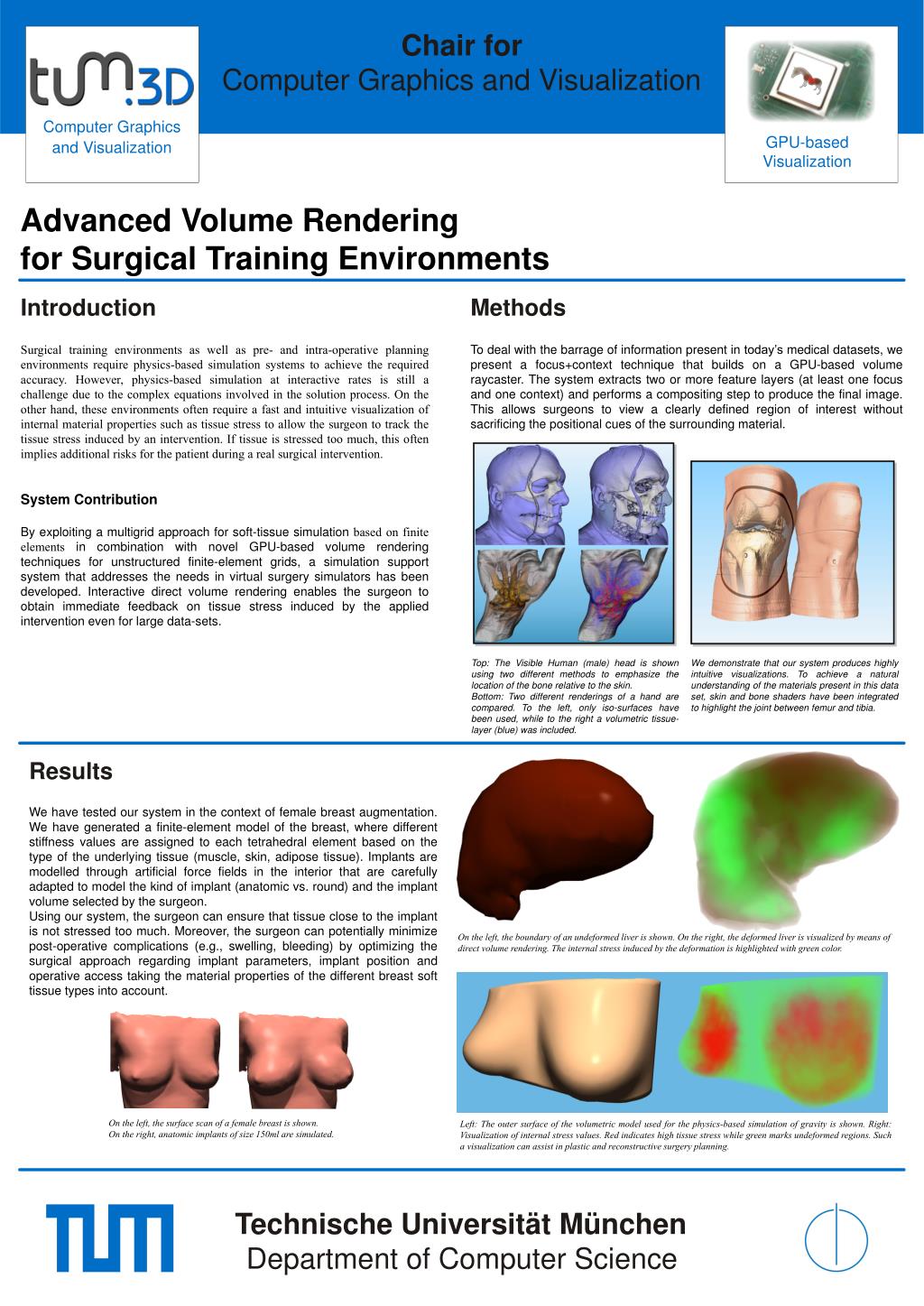
This paper presents a novel simulation support system designed for surgical training environments, utilizing a multigrid approach for soft-tissue simulation and innovative GPU-based volume rendering techniques. A focus-context visualization method enables surgeons to receive immediate feedback on tissue stress while preserving essential positional cues. Tested in applications like breast augmentation, the system models tissue properties and assesses implant placement to minimize complications and improve surgical outcomes. Results demonstrate highly intuitive visuals aiding planning and execution in plastic and reconstructive surgeries.
Advanced GPU-based Visualization for Surgical Training Environments - slide 1
01 / 1Advanced GPU-based Visualization for Surgical Training Environments
1 / 17

Télécharger la présentation

Advanced GPU-based Visualization for Surgical Training Environments
Une image / un lien ci-dessous est fourni (tel quel) pour télécharger la présentation

Politique de téléchargement : le contenu du site vous est fourni TEL QUEL pour votre information et votre usage personnel ; il ne peut être vendu, concédé sous licence ni partagé sur d’autres sites sans l’accord de son auteur.Le contenu vous est fourni TEL QUEL, pour votre information et votre usage personnel uniquement. Téléchargez la présentation en cliquant sur ce lien. Lors du téléchargement, si vous ne parvenez pas à télécharger une présentation, l’éditeur a peut-être supprimé le fichier de son serveur.Pendant le téléchargement, si vous ne parvenez pas à obtenir une présentation, le fichier a peut-être été supprimé par l’éditeur.

F I N

Plus de contenu associé

Transcription de la présentation
  1. Chair for Computer Graphics and Visualization Computer Graphics GPU-based Visualization and Visualization Advanced Volume Rendering for Surgical Training Environments Introduction Surgical training environments as well as pre- and intra-operative planning environments require physics-based simulation systems to achieve the required accuracy. However, physics-based simulation at interactive rates is still a challenge due to the complex equations involved in the solution process. On the other hand, these environments often require a fast and intuitive visualization of internal material properties such as tissue stress to allow the surgeon to track the tissue stress induced by an intervention. If tissue is stressed too much, this often implies additional risks for the patient during a real surgical intervention. System Contribution By exploiting a multigrid approach for soft-tissue simulation based on finite elements in combination with novel GPU-based volume rendering techniques for unstructured finite-element grids, a simulation support system that addresses the needs in virtual surgery simulators has been developed. Interactive direct volume rendering enables the surgeon to obtain immediate feedback on tissue stress induced by the applied intervention even for large data-sets. Methods To deal with the barrage of information present in today’s medical datasets, we present a focus+context technique that builds on a GPU-based volume raycaster. The system extracts two or more feature layers (at least one focus and one context) and performs a compositing step to produce the final image. This allows surgeons to view a clearly defined region of interest without sacrificing the positional cues of the surrounding material. Top: The Visible Human (male) head is shown using two different methods to emphasize the location of the bone relative to the skin. Bottom: Two different renderings of a hand are compared. To the left, only iso-surfaces have been used, while to the right a volumetric tissue-layer (blue) was included. We demonstrate that our system produces highly intuitive visualizations. To achieve a natural understanding of the materials present in this data set, skin and bone shaders have been integrated to highlight the joint between femur and tibia. Results We have tested our system in the context of female breast augmentation. We have generated a finite-element model of the breast, where different stiffness values are assigned to each tetrahedral element based on the type of the underlying tissue (muscle, skin, adipose tissue). Implants are modelled through artificial force fields in the interior that are carefully adapted to model the kind of implant (anatomic vs. round) and the implant volume selected by the surgeon. Using our system, the surgeon can ensure that tissue close to the implant is not stressed too much. Moreover, the surgeon can potentially minimize post-operative complications (e.g., swelling, bleeding) by optimizing the surgical approach regarding implant parameters, implant position and operative access taking the material properties of the different breast soft tissue types into account. On the left, the boundary of an undeformed liver is shown. On the right, the deformed liver is visualized by means of direct volume rendering. The internal stress induced by the deformation is highlighted with green color. On the left, the surface scan of a female breast is shown. On the right, anatomic implants of size 150ml are simulated. Left: The outer surface of the volumetric model used for the physics-based simulation of gravity is shown. Right: Visualization of internal stress values. Red indicates high tissue stress while green marks undeformed regions. Such a visualization can assist in plastic and reconstructive surgery planning. Technische Universität München Department of Computer Science