Disaster Medical Operations
120 likes | 241 Vues
In a disaster situation, Community Emergency Response Teams (CERT) play a vital role in saving lives by providing immediate assistance when professional rescuers are not available. Through training, CERT personnel can reduce fatalities by up to 40% by addressing life-threatening conditions such as airway obstructions, bleeding, and shock. This guide outlines the key skills and techniques necessary for CERT members, including airway management and bleeding control. For further details, visit the CERT website or access online introductory courses.


Disaster Medical Operations
E N D
Presentation Transcript
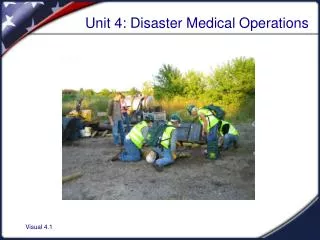
Disaster Medical Operations Operations of Community Emergency Response Teams (CERT)
Introduction In a disaster, there are more victims than rescuers and immediate help is not always available. • CERTs are integral to reducing the number of lives lost. • The number of lives lost in disaster can be reduced up to 40% by providing simple medical care CERT personnel are trained to provide: • Treatment for life-threatening conditions • Airway obstruction • Bleeding • Shock • Other less urgent conditions • The greatest good for the greatest number of victims • Simple triage For more information about CERT and what they do, visit the CERT website at: http://www.fema.gov/community-emergency-response-teams
Treating Life-Threatening Conditions: Opening the Airway The most common airway obstruction in the tongue. Head-Tilt Method for Opening an Airway: • At an arm’s distance, shake the victim by touching the shoulder and shout, “Can you hear me?” • If the victim does not or cannot respond, place the palm of one hand on the forehead. • Place two fingers of the other hand under the chin and tilt the jaw upward while tilting the head back slightly.
Opening the Airway continued • Place your ear over the victim’s mouth, looking toward the victim’s feet, and place a hand on the victim’s abdomen • Look for chest rise • Listen for air exchange • Feel for abdominal movement
Opening the Airway Tutorial Link: http://www.youtube.com/watch?v=oTHe8qKoMqo
Treating Life-Threatening Conditions: Controlling Bleeding Uncontrolled bleeding can be very serious. • Initial symptom is weakness • Within a short period of time, a person can go into shock • An adult has approximately 5 liters of blood, loss of 1 liter can result in death.
Controlling Bleeding continued There are three types of bleeding, each type can be identified based on how fast the blood flows. • Arterial Bleeding: Arteries transport blood under high pressure. Arterial bleeds are characterized by spurting blood. • Venous Bleeding: Veins transport blood under low pressure. Bleeding from a vein can be characterized as flowing. • Capillary Bleeding: Capillaries carry blood under low pressure. A capillary bleed oozes.
Controlling Bleeding: Pressure Points Brachial Pressure Point Femoral Pressure Point
Treating Life-Threatening Conditions: Recognizing Shock Shock results from the circulation of blood being ineffective. Untreated shock will lead to the death of: • Cells • Tissues • Entire Organs Signs of shock are initially compensated for by the body. It is important to continually watch for signs of shock. Main signs of shock to look for: • Rapid and shallow breathing • Capillary refill (underneath fingernails) is greater than 2 seconds • Failure to follow simple commands, i.e. “Squeeze my hand”. • Changes in skin color
CERT Certification To find a CERT near you and to get more information about getting certified visit: http://www.citizencorps.gov/cc/CertIndex.do?submitByState= For access to the online CERT Introductory course, visit: http://www.citizencorps.gov/cert/IS317/