Download
1 / 12
120 likes | 292 Vues
This article explores the principles of electric and magnetic multipole moments in nuclear physics, focusing on the implications of charge distribution within the nucleus. It outlines how electric multipole moments, particularly odd-order moments, must vanish in stationary states, adhering to time reversal symmetry. The text also delves into the significance of finding an electric dipole moment in neutrons and what it implies regarding time reversal symmetry violations. Furthermore, it discusses the classical and quantum mechanical contexts of magnetic multipole moments and the g-factors for protons, neutrons, and electrons.

E N D
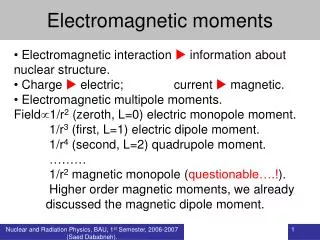
Electric Multipoles • The electric energy associated with the electric charge distribution in the nucleus is determined by the interaction of the nuclear charge distribution with electric fields.
QM Analog for the Nucleus • Vn is the multipole operator of order n • is the nuclear wave function • For all fixed-parity states, the contribution from all odd multipole operators is zero!
Electric Multipole Moments • All odd electric multipole momentsmust vanish for stationary states (e.g., nuclei, nucleons, etc.) • Therefore, nuclei must not have • Electric dipole moments (n = 1) • Electric octupole moments (n = 3) • Etc… • Search for electric dipole moment for neutron
Electric Multipole Moments • In more general terms -- • All odd electric multipole momentsmust vanish if the nuclear system is time-reversible - i.e., if it obeys time reversal symmetry. • Find an electric dipole moment for neutron implies time reversal symmetry violation!
Magnetic Multipole Moments • Classically, a circulating current induces a magnetic dipole moment -- • where A is the area enclosed by i. • If i is due to a single chargee moving with velocity v, we get --
Magnetic Multipole Moments • If i is due to a single chargee moving with velocity v, we get --
g-factors For the proton For the neutron
g-factors For the electron For the proton For the neutron