Advanced Techniques in RF GSS QUIPPS II for Perfusion Imaging of Blood Volume
This document outlines the QUIPPS II protocol for saturating the volume of interest (VOI) in blood perfusion imaging. It discusses the process of tagging incoming blood, selectively eliminating the bottom half of the bolus, and timing the tagged bolus as it reaches the VOI. The resulting perfusion image is derived by subtracting the control image from the tagged image to evaluate blood flow dynamics. This methodology enables improved visualization and analysis of perfusion patterns in vascular research.

Advanced Techniques in RF GSS QUIPPS II for Perfusion Imaging of Blood Volume
E N D
Presentation Transcript
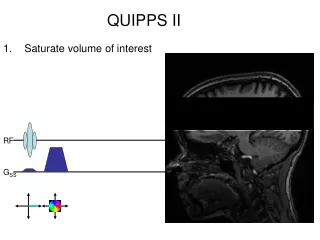
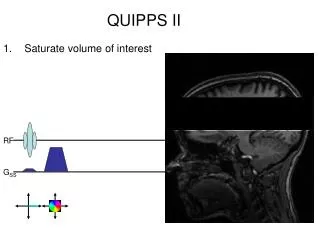
QUIPPS II • Saturate volume of interest RF GSS
QUIPPS II • Saturate volume of interest • Tag (invert) incoming blood RF GSS
QUIPPS II • Saturate volume of interest • Tag incoming blood • Kill bottom half of bolus RF GSS
QUIPPS II • Saturate volume of interest • Tag incoming blood • Kill bottom half of bolus • Wait for the rest to enter VOI • Image Read-out follows this pulse. Time it takes tagged bolus to reach VOI RF GSS
QUIPPS II • Perfusion image = control minus tagged • In tagged image, inverted spins from labeled blood decrease net magnetization