
SlideServe
Menu
Préférences
© SlideServe · v2026

Tuberculosis Education for Community Health
lenci avatar
13 diapositives · 174 Views · Mar 13, 2014

The TEACH Program by Dr. Juzar Ali aimed at improving TB education among medical students, faculty, and community venues. It focused on awareness, misconceptions, communication skills, and community engagement.
Tuberculosis Education for Community Health - slide 1
01 / 13Tuberculosis Education for Community Health
1 / 17

Télécharger la présentation

Tuberculosis Education for Community Health
Une image / un lien ci-dessous est fourni (tel quel) pour télécharger la présentation

Politique de téléchargement : le contenu du site vous est fourni TEL QUEL pour votre information et votre usage personnel ; il ne peut être vendu, concédé sous licence ni partagé sur d’autres sites sans l’accord de son auteur.Le contenu vous est fourni TEL QUEL, pour votre information et votre usage personnel uniquement. Téléchargez la présentation en cliquant sur ce lien. Lors du téléchargement, si vous ne parvenez pas à télécharger une présentation, l’éditeur a peut-être supprimé le fichier de son serveur.Pendant le téléchargement, si vous ne parvenez pas à obtenir une présentation, le fichier a peut-être été supprimé par l’éditeur.

F I N

Plus de contenu associé

Transcription de la présentation
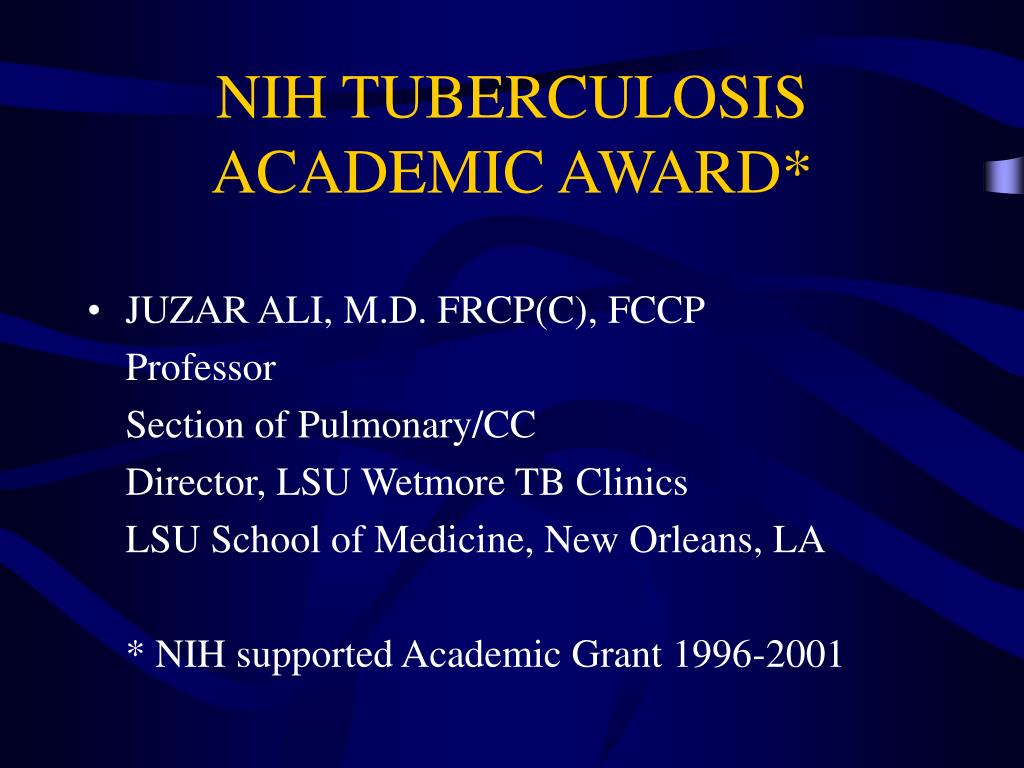
  1. NIH TUBERCULOSIS ACADEMIC AWARD* • JUZAR ALI, M.D. FRCP(C), FCCP • Professor • Section of Pulmonary/CC • Director, LSU Wetmore TB Clinics • LSU School of Medicine, New Orleans, LA • * NIH supported Academic Grant 1996-2001

  2. “TEACH” PROGRAM • Tuberculosis Education Aimed at Community Health

  3. Components • MEDICAL STUDENTS* • Invited through the Student Affairs Office* and the Department of Minority Affairs and Community Health , LSU* • UNIVERSITY FACULTY* • Program Director and assigned faculty of the Section* • COMMUNITY VENUES* • Included but not limited to under the auspices of the State and City TB Clinics* Network • * Cooperation/assistance gratefully acknowledged

  4. Medical Student Objectives • At the end of the TEACH program, the participating student will be able to: • 1. Have an increased awareness of the public health importance of tuberculosis • 2. Increase his/her knowledge base of the subject • 3. Identify public misconceptions about TB and appreciate cultural and ethnic differences in their comprehension. • 4. Enhance communication skills and establish a base for future leadership role in public health.

  5. Faculty Objectives • At the end of the TEACH program, the faculty will be able to : • 1. Appreciate the current epidemiology of tuberculosis and the need for a multi-disciplinary approach in imparting TB education • 2. Establish a liaison between academic medicine, community organizations and public health systems to improve education and increased awareness of TB

  6. Community Objectives • At the end of the TEACH program, the participating community venues will be able to : • 1. Have an increase awareness of TB in their particular community setting • 2. Establish direct lines of communication and have access to a resource base of university and public health network • 3. Have a forum of discussing practical TB management problems

  7. DESIGN AND FORMAT OF TEACH PROGRAM Faculty Core Curriculum * 1 MS (2) MS (2) MS (2) MS (2) Pre-Session Briefing A B C D Community Venues 2 3 Faculty & Students Groups Meet Concluding Workshop Post-sessions Briefing Collect data for informational brochure * MS= medical students team

  8. Greater New Orleans Area: *Region 1; 5 parish areas Lake Ponchartrain *(1997) Orleans: TB cases= 20.6/100K Public Health Clinics *(1997) Jefferson Parish: TB cases=9.2/100K LSU-TB CLINIC PH/DIS NURSE Mississippi river Public Health Clinics *ALGIERS *GRETNA *Public Health Clinic, Marrero

  9. Products • Question/Answer Brochure-Newsletter • Community Projects • Manuscript by students Family / Primary physicians Community outreach venues

  10. Evaluation • Students: • 1. Pre / post questions • 2. Faculty review • 3. Audience review • Community Venues: • 1. Evaluation Sheets • 2. Impact on Screening and contact time • 3. Follow up interviews

  11. “TEACH” Program: Evaluation Steps* ( DATA published in Minority Health, Vol.1,#5 July 2000 1. Student Evaluation: Instruments At point A^…..pre test Questionnaire 30 questions At Point C…..post test Questionnaire 20+10 ^… n=21 students; 3 categories 21 had < 20 answers correct 2. Evaluation of program: At point B^^ …………………………….Rating Scale 80-90 % had positive comments 1-6 ( n=12) * based on reliability coefficient and dichotomy rating scale

  12. Medical students: RESULTS PRE TEST SCORE POST TEST SCORE P value N=21; 30 questions n=20; 30 questions 60.95 +- 1.85 77.5 +- 1.95 <0 .0001 N=21; 30 questions n=20; 41 questions 60.95 +- 1.85 77.93 +- 1.8 < 0.0001

  13. Overall Impact: Outcome data # of clinic visits # of persons screened for TB # of PPD return rates At a Student Run Faculty Supervised Homeless clinic in New Orleans ( 6 month data) 80 PPD’s planted; 38 returned to the read 7 had PPD greater than 4 mm and were referred to the LSU/ Wetmore TB Clinic for further follow-up Data Published in Jour of LA State Medical society Vol 152 # 8, August 2000 Pg 398-404