Understanding the Cell Cycle: Mitosis Explained
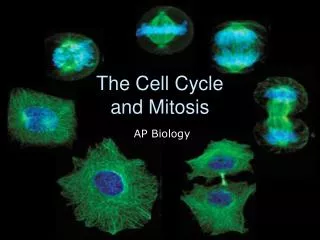
The cell cycle is a crucial process where cells reproduce exact duplicates for various reasons such as replacement, repair, and growth. It involves three main phases: Interphase (where DNA replication occurs), Mitosis (the division of the nucleus forming two identical daughter cells), and Cytokinesis (the division of the cytoplasm). During Interphase, DNA exists as loosely organized chromatin, which condenses into chromosomes during Mitosis. The cycle ensures that each new cell contains identical DNA, vital for the organism's growth and maintenance.

Understanding the Cell Cycle: Mitosis Explained
E N D
Presentation Transcript
Cells constantly reproduce exact duplicates of themselves. Why? • Replacement • Repair • Growth
Cells must make an exact copy of their DNA • DNA is the blueprint of the cell and is found in the nucleus
Cell growth and division happens in a series of recognizable steps called the Cell Cycle • Rephrase: what is the cell cycle?
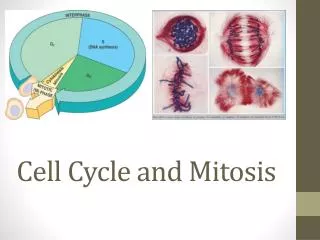
Cell cycle has three phases • 1. Interphase • Cell growth • DNA replication occurs • 2. Mitosis • Nuclear division • 2 daughter cells formed, each has identical DNA • 3. Cytokinesis • 2 identical cells
DNA forms chromosomes- • For most of the cell’s life, DNA is arranged “loosely” in the form of chromatin • During mitosis DNA condenses into chromosomes
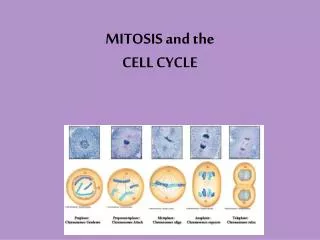
Interphase • Longest phase • Cell grows • Chromosomes are duplicated- each duplicate is called a sister chromatid
Prophase • Nuclear envelope breaks down • Sister chromatids joined at centromere • Centrioles move to opposite ends and the spindle fibers form between them
Metaphase • Short • Spindle fibers attach to centromere • Sister chromatids line up along midline
Anaphase • Sister chromatids are pulled apart by the spindle fibers
Telophase • Final phase of mitosis- opposite of prophase • Chromatids reach opposite poles • Nuclear envelope reforms • Chromosomes unwind
Cytokinesis • Cytoplasm division • Cytokinesis differs between plants and animals- why?