Exploring History: Understanding Primary and Secondary Sources
In this lesson, students will engage in a collaborative activity to differentiate between primary and secondary sources in history. The aim is to uncover how historians gather evidence about the past and what these sources reveal about people’s lives. Students will work in pods to analyze artifacts, share findings, and respond to essential questions about the nature of historical evidence. By the end of the lesson, they should be able to explain the significance of primary sources and reflect on the challenges historians face in their work.

Exploring History: Understanding Primary and Secondary Sources
E N D
Presentation Transcript
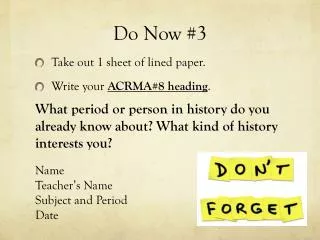
Do Now #3 • Take out 1 sheet of lined paper. • Write your ACRMA#8 heading. What period or person in history do you already know about? What kind of history interests you? Name Teacher’s Name Subject and Period Date
Unit Zero: How we do History Learning Objective: Students will learn the difference between primary and secondary sources though a collaborative group activity. Students will be accessed by their advanced organizer.
AGENDA • Do Now • Essential Questions • Sources in History • Think-Pair Share • Collaborative Station (Advanced Organizer) • Exit Slip
Essential Questions “History” • How can we know about how people lived, if we were not there?
Primary & Secondary Sources • Primary Sources are the raw materials of history – original documents and objects which were created at the time under study. They are different from Secondary Sources, accounts or interpretations of events created by someone without first-hand experience.
Collaborative Station • STEP 1: Share your index card from yesterday’s homework in your pod (pass index card to the right). • STEP 2: Pretend to be a future Historian 1,000 years from now, what do these artifacts tell you about the people in this classroom? • STEP 3: Write your findings in the Advanced Organizer • 4 Artifacts per pod, make 3 conclusions about each artifact
Exit Slip Is a Historian’s job difficult? Why or why not?
Dismissal • Wait for my signal • Put away your materials • Students will be dismissed by pod