Download

1 / 3
30 likes | 136 Vues
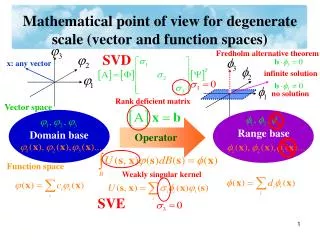
Explore the mathematical perspective on degenerate scales in Laplace and Navier equations, understanding the relationships between Boundary Integral Equation (BIE) and Partial Differential Equation (PDE) formulations. From vector and function spaces to Fredholm alternative theorem, delve into the nuances of operator ranges, domains, and singular kernels.

E N D
Mathematical point of view for degenerate scale (Laplace and Navier equations) Feng Kang (馮康院士) BIE and PDE are not equivalent Hu Hachang (胡海昌院士) (錢令希院士) The solution of PDE satisfies the BIE ? The solution of BIE satisfies the PDE ? A necessary and sufficient BIE formulation ? 1
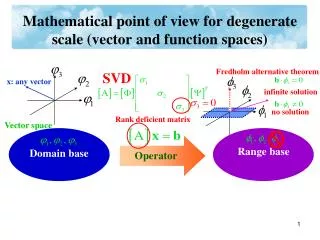
Operator Range base Domain base Mathematical point of view for degenerate scale (vector and function spaces) Fredholm alternative theorem SVD x: any vector infinite solution no solution Rank deficient matrix Vector space Fredholm alternative theorem Not sufficient: add constraint infinite solution Not necessary no solution
Mathematical point of view for degenerate scale (vector and function spaces) Operator Range base Domain base Function space Weakly singular kernel SVE Fredholm alternative theorem Not sufficient: add constraint infinite solution: b no \phi_3 3 no solution: b there is \phi_3 Not necessary