The Significance of Euler's Number: Understanding Natural Logarithms and Exponential Functions
110 likes | 227 Vues
The number e, approximately 2.71828, is a pivotal irrational number in mathematics, commonly known as Euler's number. It serves as the base of natural logarithms, a concept pioneered by John Napier. The natural logarithm enables us to determine the time required to reach specific growth levels in continually growing processes. This guide explores the essential calculations and equations involving e, juxtaposing exponential and logarithmic functions, and highlights applications in modeling continuous growth and decay across various scientific fields.


The Significance of Euler's Number: Understanding Natural Logarithms and Exponential Functions
E N D
Presentation Transcript
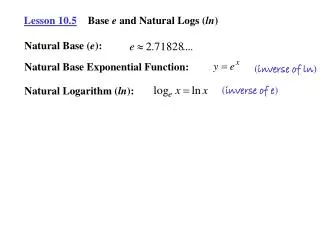
History The number e is a famous irrational number, and is one of the most important numbers in mathematics. The first few digits are 2.7182818284590452353602874713527... It is often called Euler's numberafter Leonhard Euler. e is the base of the natural logarithms (invented by John Napier).
Calculating The value of (1 + 1/n)n approaches e as n gets bigger and bigger:
Vocabulary natural base: the number e, which is found using • the base rate of growth shared by all continually growing processes • Used heavily in science to model quantities that grow & decay continuously natural base exponential function: an exponential function with base e
Vocabulary natural logarithm:a logarithm with base e The natural log gives you the time needed to reach a certain level of growth. natural logarithmic function: the inverse of the natural base exponential function
Ex 1 Ex 2 Use a calculator to estimate to four decimal places. Ex 3 Ex 4
Writing Equivalent Expressions Ex 5 Exponential logarithmic Write an equivalent equation in the other form. Ex 6 Ex 7 Ex 8
Writing Equivalent Expressions Ex 9 Ex 10 Evaluate Evaluate Ex 11 Ex 12 Evaluate Evaluate
Solving Equations Solve the following equations. Ex 13 Ex 14
Solving Equations Solve the following equations. Ex 15 Ex 16