Download
1 / 16
160 likes | 266 Vues
This lesson focuses on translating word phrases into algebraic expressions. Students will learn how to identify operations based on phrases, use variables to represent unknown numbers, and derive expressions from given tables or comparative phrases. Key operations covered include addition, subtraction, multiplication, and division. It features examples to illustrate how to write expressions for specific scenarios, such as comparing ages. By mastering these skills, students will enhance their understanding of algebra and problem-solving techniques.

E N D
Writing Algebraic Expressions Lesson 2-3
Word phrases can be written as algebraic expressions. • Use the words to determine what operation you are using. • Use a variable for the phrase “a number.”
Adding Phrases • Plus • More than • Sum • Increased by
Subtracting Phrases • Minus • Difference • Subtracted from • Decreased by • Less than
Multiplying Phrases • Times • Product of Dividing Phrases • Quotient • Divided by
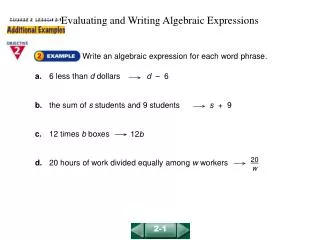
Example: 7 decreased by b “Decreased by” means subtract. 7 - b
Example: The product of 19 and k “Product” means multiply. We show multiplication by placing the factor right next to the variable. 19k
Less than, more than • Some word phrases contain the words “less than” or “more than.” • When you see those words, start with the second part of the phrase. Example: 23 less than m m - 23
Example: 32 less than 5 times c The 32 is less than the 5 times c, which means we subtract 32 from the 5 times c. So, start with 5 times c. 5c - 32
Tables • When you are given a table of values, determine how to get from the first column to the second column. • Describe that pattern with an algebraic expression.
Example n ? 3 12 7 28 11 44
Compare from left to right. • How do we get from 3 to 12? Add 9 or multiply by 4. • How do we get from 7 to 28? Multiply by 4. • If we multiply 11 by 4, we get 44. The pattern is to multiply our number, n, by 4. The algebraic expression to describe this is: 4n
Describing Unknown Numbers • When you don’t know what a number is, let a variable stand for that number. • Use an algebraic expression to describe what you’re looking for.
Example Write an algebraic expression to describe Jerry’s age. Use the following information: Jerry is 4 years younger than his brother Steve. First, we have to know how old Steve is. We do not have an age for Steve, so we will use a variable: Let s = Steve’s age. Now that we have determined Steve’s age (s), we can use it to determine Jerry’s age. Jerry is 4 years younger than Steve. s - 4
If Steve is 22 years old, then how old is Jerry? s - 4 Jerry is 18 years old. 22 - 4 18