Download
1 / 24
240 likes | 344 Vues
In this activity, we explore the molecular formula of a compound with an empirical formula of C3H4O2 and a molar mass of 144 g/mol. We also dive into various types of chemical reactions, including combustion, synthesis, decomposition, single replacement, and double replacement. This lesson aims to equip students with the necessary terminology and understanding to classify reactions and comprehend everyday chemical changes, such as the interactions of baking soda and vinegar. Join us to enhance your knowledge and academic performance!

E N D
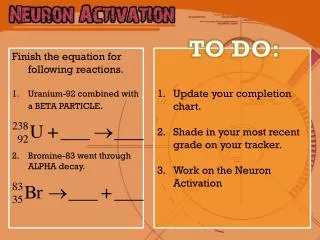
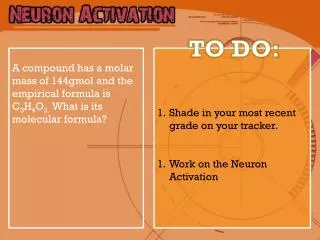
TO DO: A compound has a molar mass of 144gmol and the empirical formula is C3H4O2. What is its molecular formula? Shade in your most recent grade on your tracker. Work on the Neuron Activation
80% Brilliance! • Brandi Brisby • Alexis Brown • Latrista Carter • Anita Christopher • Rakeen Fry • Hannah Gammill • Shay Gatlin • GerricaHolmes • Donald Jackson • Jalessa Johnson • Kenny King • Sam Laney • Donovan Moore • Barnisha Pam • Brittany Preston • Big Mike Sanders • Daniel Rawls • AquasheyuiaTaylor • DaneishaWillis • Shaquitta Wright
Jaleel Bolden • LaClareion Buck • Kevin Cheeter • Jasmine Cusic • Kelsey Franklin • QuadariusGadison • Alex Hardy • Anthony Hicks • Kenneth James • Keltran Jefferson • Kenny Lee • Rachel Lewis • Tarnisha Preston • Jasmine Robinson • LeasiaLittleton • QuintariusWillis • JamarcusYoung 80% Brilliance!
80% Brilliance! • Deneisha Carey • KiaraCollier • Terrance Gray • Anthony Harris • Dexter Hemphill • GerMareonHenry • Pinky Howard • Samantha Hurt • Shandrequa Ireland • Isaac Coleman • Kenyatta Kingdom • Amber Meekds • Markeda Payne • GybrinaSimmons • Gabrielle Thomas • Raven Thompson
Baking Soda and Vinegar: NaHCO3(aq) + 2 HC2H3O2 (aq) H2O(l) + CO2(g) + 2NaC2H3O2 (aq) Candles: 2C20H42 (s) + 61O2 (g) -> 40CO2 (g) + 42H2O (aq)
The Breakdown of the Day • Explore – Chemical Reactions • Understand – Identify 5 types of chemical reactions. • Opportunity – Gain terminology to explain everyday changes ChemMastery
Question:Does your reaction have oxygen as one of its reactants and carbon dioxide and water as the products? C6H12O6+ 6 O2 6 CO2 + 6 H2O Reaction Type:
Question:Does your reaction have two (or more) chemicals combining to form one chemical? 2 H2 + O2 2 H2O Reaction Type:
Question:Does your reaction have one large molecule falling apart to make several small ones? Ni(ClO3)2 NiCl2 + 3 O2 Reaction Type:
Question:Does your reaction have any molecules that contain only one element? 2 KI + Cl2 2 KCl + I2 Reaction Type:
Question:Is your reaction swapping cations? Cd3(PO4)2 + 3 (NH4)2S 3 CdS + 2 (NH4)3PO4 Reaction Type:
Reactions Rap • Combustion all you gotta’ see is O2 and CO2 • Synthesis: All you have to do is put them togetha’, put them togetha’ • Decomposition: All you have to do is take them apart, take them apart • Single Replacement: All you have to see is that one element, that one element • Double Replacement: All you have to do is swap those cat ions, swap those cations
Guided Practice 10 Questions
Classify the following reaction. A. CombustionB. SynthesisC. DecompositionD. Single ReplacementE. Double Replacement
Classify the following reaction. A. CombustionB. SynthesisC. DecompositionD. Single ReplacementE. Double Replacement
Classify the following reaction. A. CombustionB. SynthesisC. DecompositionD. Single ReplacementE. Double Replacement
Classify the following reaction. A. CombustionB. SynthesisC. DecompositionD. Single ReplacementE. Double Replacement
Classify the following reaction. A. CombustionB. SynthesisC. DecompositionD. Single ReplacementE. Double Replacement
Classify the following reaction. A. CombustionB. SynthesisC. DecompositionD. Single ReplacementE. Double Replacement
Classify the following reaction. A. CombustionB. SynthesisC. DecompositionD. Single ReplacementE. Double Replacement
Classify the following reaction. A. CombustionB. SynthesisC. DecompositionD. Single ReplacementE. Double Replacement
Classify the following reaction. A. CombustionB. SynthesisC. DecompositionD. Single ReplacementE. Double Replacement
Classify the following reaction. A. CombustionB. SynthesisC. DecompositionD. Single ReplacementE. Double Replacement