Evaluating Stacked Ecosystem Services for Property Value in Central North Carolina
This study investigates the value of stacked ecosystem services (SES) such as nutrient retention, carbon sequestration, and water runoff management in the context of rapidly developing areas like the Upper Neuse River Basin in North Carolina. By comparing property values and SES values, we analyze their competitiveness, particularly given projected population growth and land value increases. Utilizing various models and methods, we assess the potential for market creation around carbon storage and water runoff services. Our findings suggest that SES can compete with traditional tax values, highlighting opportunities for sustainable land management.

Evaluating Stacked Ecosystem Services for Property Value in Central North Carolina
E N D
Presentation Transcript
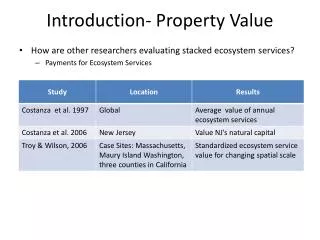
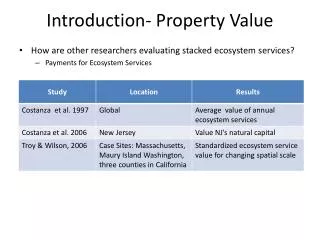
Introduction- Property Value • How are other researchers evaluating stacked ecosystem services? • Payments for Ecosystem Services
Introduction- Property Value • How are we evaluating stacked ecosystem services? • Property Value vs. Stacked Ecosystem Service Value • Stack One: Nutrient Retention, Carbon Sequestration, Pollination • Stack Two: Carbon Storage, Water Runoff • In an area with rapid development and increasingly high land values, will the value of stacked services be able to compete? • Is there potential for creating markets for carbon storage and water runoff?
Study Site • Upper Neuse River Basin, Central North Carolina • Current Population = 190,000 • Projected Population in 2025 = 280,000 www.unrba.org
Property Value Methods • Property Value • Taken from Triangle Land Conservancy • Convert Property Value to $/900 sq-m (30 meter resolution) • 20 year values
Property Value Methods • Division of Quantiles • Property value ($) divided by stacked ecosystem service value ($) • Order of Magnitude • No Data • Ecosystem Service Value is 0 • No data on property value: Govt. Owned Sites
Nutrient Retention Methods • Nitrogen Loading Caps • NCAC 15A Rule .0234 and .0279.Rule .0234 (6) (A) • Cost • NC DENR/DWQ WARMF Report • Estimates nitrogen offset rate of $44/lb of nitrogen • Translates to $97/kg for a 20 year period at 1% discount rate*
Water Runoff Methods • InVEST Water Yield Model • Convert all agricultural and forest land cover/land use data to urban • Assume change in water yield is the run-off expected • Costs of storm-water BMP’s for Upper Neuse River Basin • Substituted values for study performed in Mecklenburg County, NC (American Forests, 2010) • Unit cost of $2-6/cubic ft to mitigate additional storm-water runoff
Carbon Storage Methods • Output from InVEST model • Social Cost: $154/tCO2 (Frankhauser and Tol 1996) • Current European Market Cost: $74/tCO2
Carbon Sequestration Methods • Annual NPP for each land cover in watershed at both social and middle cost • 20 year period with 1% discount rate
Pollination Methods • InVEST Model Output • Normalize relative scale • Reclassify to percentiles • Managed Pollinator Estimate • Best Pollination Service Dollar Value: • $50 for 1 pallets, 1 acre, 1 season • INPUT VALUE = $300 for 2 pallets, 1 acre, year = 3 seasons • Convert $/acre to $/pixel at 30 meter resolution • 20 year value with a 1% discount rate*
Stacked ES Values Methods Overlay all value maps: Areas of high dollar value for ES are lighter.
Stacked ES Values Methods • One-time ES costs • Carbon Storage • Water Runoff • 20-Year Value • Carbon Sequestration • Nutrient Retention • Pollination
FINAL REMARKS • We have shown that ES can compete with Tax values • Carbon and stacked values, esp top quartile • Would this actually work? • Currently carbon trades for $0.10 tCO2 • Heterogeneity • Link results to heterogeneity
Final Remarks • Big Picture of ES & Biodiversity & Stacked Services
THANKS! • Taylor Ricketts, Other people we worked with at WWF • Contributing Professors • The Triangle Land Conservancy (TLC) • Others?