

SlideServe
Menu
Préférences
© SlideServe · v2026

Suetonius

lesa avatar
1 diapositives · 340 Views · Aug 04, 2014

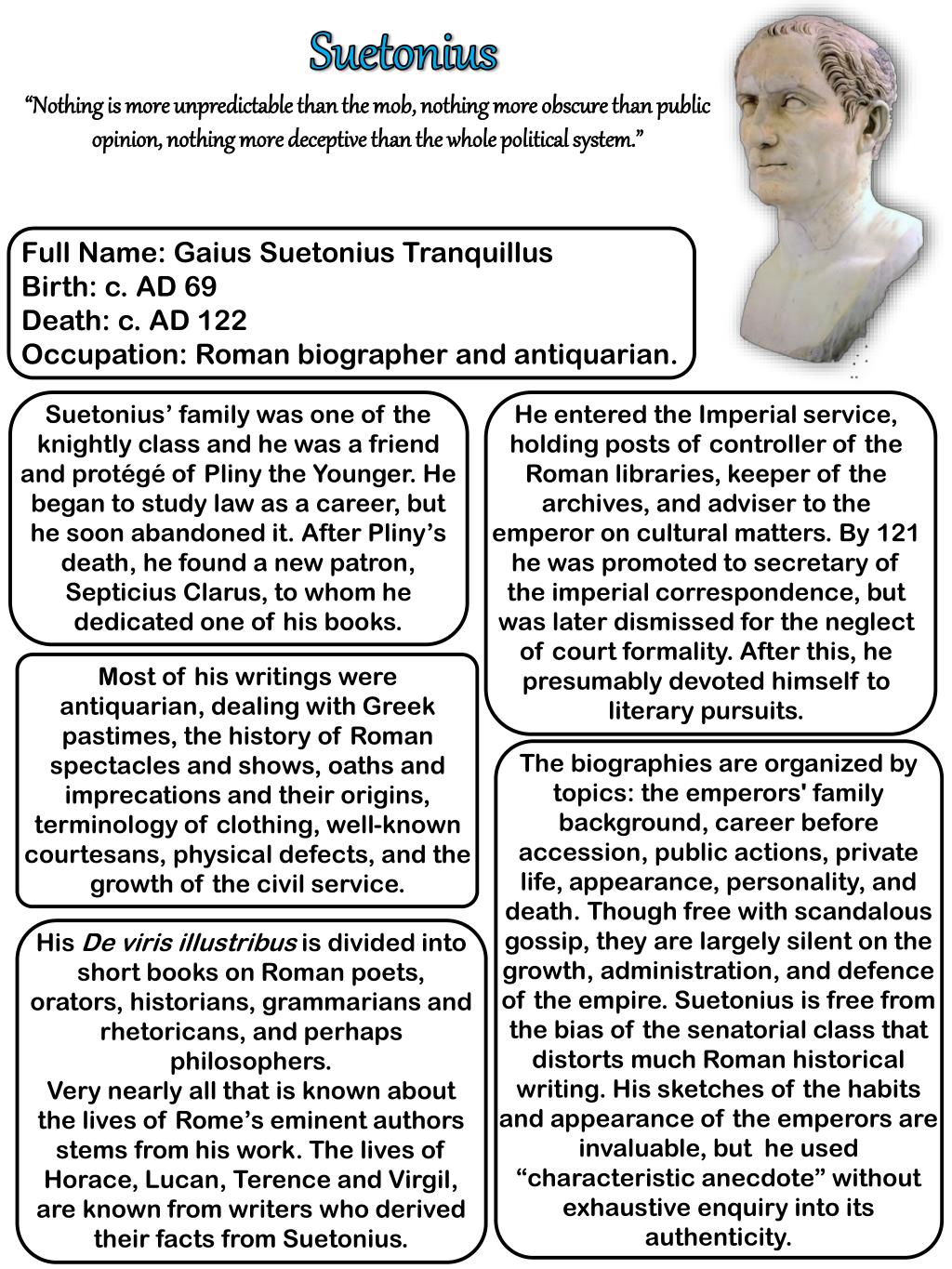
Suetonius. “Nothing is more unpredictable than the mob, nothing more obscure than public opinion, nothing more deceptive than the whole political system.”. Full Name: Gaius Suetonius Tranquillus Birth: c. AD 69 Death: c. AD 122 Occupation: Roman biographer and antiquarian.    .
Suetonius - slide 1
01 / 1Suetonius
1 / 17

Télécharger la présentation

Suetonius
Une image / un lien ci-dessous est fourni (tel quel) pour télécharger la présentation

Politique de téléchargement : le contenu du site vous est fourni TEL QUEL pour votre information et votre usage personnel ; il ne peut être vendu, concédé sous licence ni partagé sur d’autres sites sans l’accord de son auteur.Le contenu vous est fourni TEL QUEL, pour votre information et votre usage personnel uniquement. Téléchargez la présentation en cliquant sur ce lien. Lors du téléchargement, si vous ne parvenez pas à télécharger une présentation, l’éditeur a peut-être supprimé le fichier de son serveur.Pendant le téléchargement, si vous ne parvenez pas à obtenir une présentation, le fichier a peut-être été supprimé par l’éditeur.

F I N

Plus de contenu associé

Transcription de la présentation
  1. Suetonius “Nothing is more unpredictable than the mob, nothing more obscure than public opinion, nothing more deceptive than the whole political system.” Full Name: Gaius Suetonius Tranquillus Birth: c. AD 69 Death: c. AD 122 Occupation: Roman biographer and antiquarian.     Suetonius’ family was one of the knightly class and he was a friend and protégé of Pliny the Younger. He began to study law as a career, but he soon abandoned it. After Pliny’s death, he found a new patron, SepticiusClarus, to whom he dedicated one of his books. He entered the Imperial service, holding posts of controller of the Roman libraries, keeper of the archives, and adviser to the emperor on cultural matters. By 121 he was promoted to secretary of the imperial correspondence, but was later dismissed for the neglect of court formality. After this, he presumably devoted himself to literary pursuits. Most of his writings were antiquarian, dealing with Greek pastimes, the history of Roman spectacles and shows, oaths and imprecations and their origins, terminology of clothing, well-known courtesans, physical defects, and the growth of the civil service. The biographies are organized by topics: the emperors' family background, career before accession, public actions, private life, appearance, personality, and death. Though free with scandalous gossip, they are largely silent on the growth, administration, and defence of the empire. Suetonius is free from the bias of the senatorial class that distorts much Roman historical writing. His sketches of the habits and appearance of the emperors are invaluable, but he used “characteristic anecdote” without exhaustive enquiry into its authenticity. His De virisillustribus is divided into short books on Roman poets, orators, historians, grammarians and rhetoricans, and perhaps philosophers. Very nearly all that is known about the lives of Rome’s eminent authors stems from his work. The lives of Horace, Lucan, Terence and Virgil, are known from writers who derived their facts from Suetonius.