Download
1 / 1
10 likes | 154 Vues
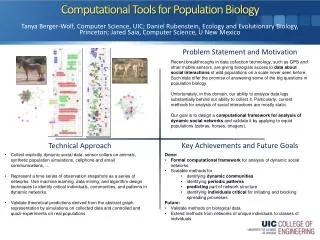
Recent advancements in data collection technologies, such as GPS and mobile sensors, enable biologists to gather unprecedented data on social interactions of wild populations. However, the analysis methods for these dynamic interactions are lagging. This project aims to develop a computational framework to analyze dynamic social networks, focusing on equid populations like zebras and horses. The framework will utilize machine learning and data mining techniques to identify critical individuals and patterns, with practical applications for validating theoretical predictions through real and simulated biological data.

E N D
Computational Tools for Population Biology Tanya Berger-Wolf, Computer Science, UIC; Daniel Rubenstein, Ecology and Evolutionary Biology, Princeton; Jared Saia, Computer Science, U New Mexico • Recent breakthroughs in data collection technology, such as GPS and other mobile sensors, are giving biologists access to data about social interactions of wild populations on a scale never seen before. Such data offer the promise of answering some of the big questions in population biology. • Unfortunately, in this domain, our ability to analyze data lags substantially behind our ability to collect it. Particularly, current methods for analysis of social interactions are mostly static. • Our goal is to design a computational framework for analysis of dynamic social networks and validate it by applying to equid populations (zebras, horses, onagers). • Collect explicitly dynamic social data: sensor collars on animals, synthetic population simulations, cellphone and email communications, … • Represent a time series of observation snapshots as a series of networks. Use machine learning, data mining, and algorithm design techniques to identify critical individuals, communities, and patterns in dynamic networks. • Validate theoretical predictions derived from the abstract graph representation by simulations on collected data and controlled and quazi-experiments on real populations • Done: • Formal computational framework for analysis of dynamic social networks • Scalable methods for • dentifyingdynamic communities • identifying periodic patterns • predicting part of network structure • identifying individuals critical for initiating and blocking spreading processes • Future: • Validate methods on biological data • Extend methods from networks of unique individuals to classes of individuals