
SlideServe
Menu
Préférences
© SlideServe · v2026

Understanding Dihybrid Crosses: Using Punnett Squares for Genetic Predictions

lester avatar
9 diapositives · 367 Views · Aug 28, 2014

Dihybrid crosses involve two traits and can be effectively represented using 16-box Punnett squares. By defining the genotypes of the parent organisms for each trait (e.g., BBhh for a homozygous black-haired short-haired female and BbHh for a heterozygous black-haired long-haired male), we can visualize the potential offspring combinations. For example, crossing these genotypes yields various phenotypes. Through practice, such as determining the hair color and length in guinea pigs, we learn to predict genetic ratios, enhancing our understanding of Mendelian inheritance and genotypic combinations.
Understanding Dihybrid Crosses: Using Punnett Squares for Genetic Predictions - slide 1
01 / 9Understanding Dihybrid Crosses: Using Punnett Squares for Genetic Predictions
1 / 17

Télécharger la présentation

Understanding Dihybrid Crosses: Using Punnett Squares for Genetic Predictions
Une image / un lien ci-dessous est fourni (tel quel) pour télécharger la présentation

Politique de téléchargement : le contenu du site vous est fourni TEL QUEL pour votre information et votre usage personnel ; il ne peut être vendu, concédé sous licence ni partagé sur d’autres sites sans l’accord de son auteur.Le contenu vous est fourni TEL QUEL, pour votre information et votre usage personnel uniquement. Téléchargez la présentation en cliquant sur ce lien. Lors du téléchargement, si vous ne parvenez pas à télécharger une présentation, l’éditeur a peut-être supprimé le fichier de son serveur.Pendant le téléchargement, si vous ne parvenez pas à obtenir une présentation, le fichier a peut-être été supprimé par l’éditeur.

F I N

Plus de contenu associé

Transcription de la présentation
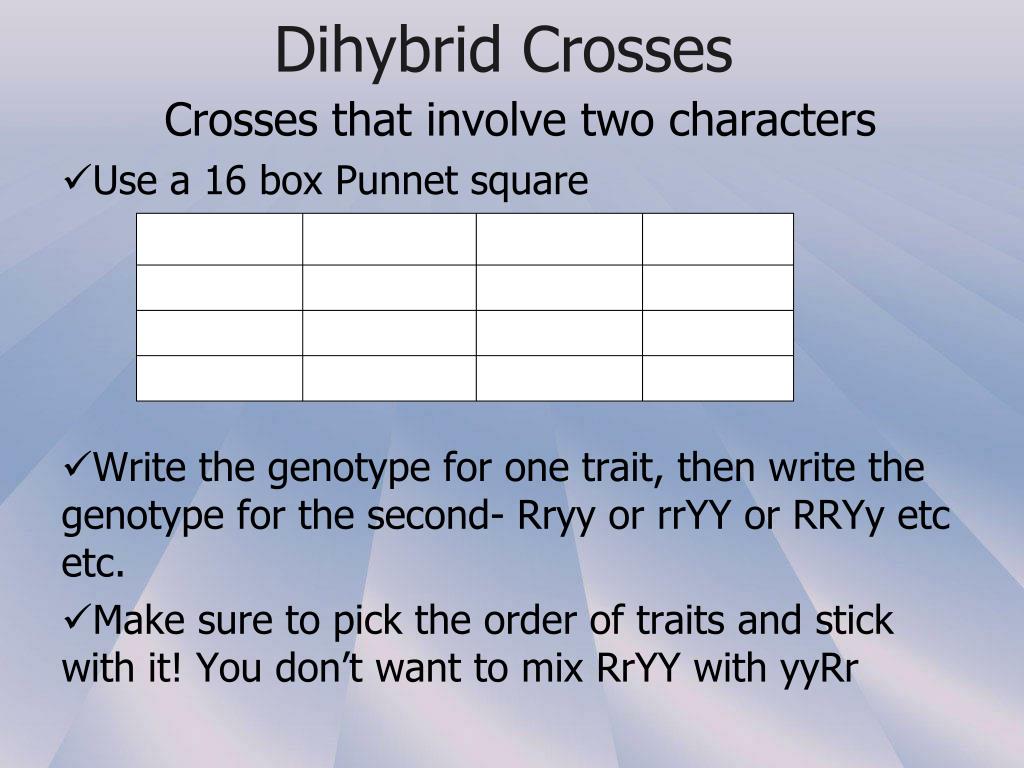
  1. Dihybrid Crosses Crosses that involve two characters Use a 16 box Punnetsquare Write the genotype for one trait, then write the genotype for the second- Rryy or rrYY or RRYyetc etc. Make sure to pick the order of traits and stick with it! You don’t want to mix RrYYwith yyRr

  2. Setting up the Punnet Square • Lets say parent one is FfRr FfRr= FR, Fr FR, Fr, fR, fr FfRr= fR, fr

  3. Setting up the Punnet Square • Lets say parent two is ffRR ffRR= fR, fR fR, fR, fR, fR ffRR = fR, fR

  4. Setting up the Punnet Square • Now, add in the genotypes of the parents to your Punnet Square: FR Fr fR fr fR fR fR fR

  5. Setting up the Punnet Square • Now Cross! FR Fr fR fr fR fR fR fR FfRR FfRr ffRR ffRr FfRR FfRr ffRR ffRr FfRR FfRr ffRR ffRr FfRR FfRr ffRR ffRr

  6. Practice Two guinea pigs met and fell in love. The female was homozygous for black hair (BB) and homozygous for short hair (hh). The male was heterozygous for black hair (Bb) and heterozygous for long hair (Hh). What is the genotype of the mom? What is the genotype of the dad? What are you going to use to set up your Punnetsquare? BBhh BbHh Bh, Bh, Bh, Bh and BH, Bh, bH, bh

  7. Bh Bh Bh Bh BH Bh bH bh BBHh BBHh BBHh BBHh BBhh BBhh BBhh BBhh BbHh BbHh BbHh BbHh Bbhh Bbhh Bbhh Bbhh How many had long black hair? Long brown hair? Short brown hair? Short black hair? 8 0 Must equal 16 0 8

  8. TR Tr tR tr TR TTRR TTRr TtRR TtRr (always 4 possibilities) TR TTRr TtRR TtRr TTRR Tall & Red Tall & White Short & Red Short & White 12 4 0 0 Tr TtRr Ttrr TTRr TTrr 12 : 4 : 0 : 0 Tr TTRr TTrr Ttrr TtRr

  9. EeLl EeLl EL El eL el EL EELL EELl EeLL EeLl El EEll EeLl Eell EELl Free hanging & Large Free hanging & Small Attached & Large Attached & Small 9 3 3 1 eL eeLL eeLl EeLL EeLl 9 : 3 : 3 : 1 el EeLl Eell eell eeLl