Having Children
This chapter delves into the significant transformations couples experience when contemplating parenthood. It discusses the evolution of family structures, including historical perspectives on childbearing in Canada and the contrast with modern-day practices. The chapter examines various influences impacting the decision to have children, such as cultural values, economics, and social norms. It highlights the irreversible commitment of parenthood, the necessity of effective family planning, and the differing parenting styles across cultures, emphasizing the implications for modern families.

Having Children
E N D
Presentation Transcript
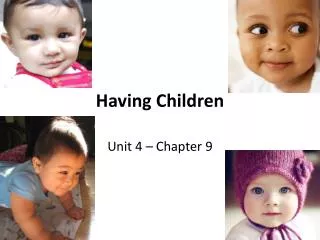
Having Children Unit 4 – Chapter 9
What are some changes that occur in the life of a couple who is making the decision to have a child?
Truth or Myth? • Until the 20th century, the average family consisted of a large extended family with at least 3 generations living in one home
Truth or Myth? • The nuclear, monogamous family has been the norm in some societies since the dawn of history.
Truth or Myth? • Throughout history the family was an economic unit until the West invented the idea of romantic love matches
Childbearing in Canada • Over 90% of Canadians say that they intend to become parents • Parenthood is an irreversible commitment – “One can have ex-spouses and ex-jobs but not ex-children.” (Ronald Rindfuss)
Childbearing in Canada • Modern Canadian families can plan when to have children, how many they will have and how they will space their children out • This wasn’t possible before the late 1960s & the invention of birth control
Childbearing in Canada • What are some factors that influence the decision of couples to have children? • Cultural values & beliefs • Economics • Social norms • Psychological & emotional needs
Children in our European Heritage • The purpose of children depended on a family’s social class • In upper class families the parent-child relationship was not important • Upper class families sent their children away until they were adults • Boys were expected to marry a suitable girl to pass on the family line
Children in our European Heritage • Lower class families needed children to contribute their labour to the family • From the time their children could walk they learned how to do chores • Children were integrated into the social life of the community once they began to work
Children in our European Heritage • Between 1500 and 1700, men were the rulers over their household • Women and children were property • Swaddling & beatings children were recommended for raising a healthy child • Parents, particularly in the lower-class, were very affectionate towards their children
Children in our European Heritage • Early European families had more children than today due to the high infant mortality rate • The maternal mortality rate meant that many women, rich and poor, died while giving birth to their last child
Parenting Around the World • If a parent did any of the following, would you consider them to be a fit or unfit parent? • Allowed their child to smoke at a young age • Allowed their child to play with fire unsupervised • Allowed their child to swim unsupervised • Went hunting with their child • Allowed their child to disappear for days at a time without knowing where they were • Allowed their child to skip school
Parenting Around the World • What are the differences between how the average Canadian family raises their children and how the Mentawai raise their children? • What are some benefits of the Mentawai style of parenting? • Could the Mentawai style of parenting work for families in Canada? Why or Why not?
Aspects of Western-style Parenting • Some aspects of Western-style parenting are seen as strange or taboo in many parts of the world • Can you think of any examples?
Aspects of Western-style Parenting Solitary sleeping vs. co-sleeping
Aspects of Western-style Parenting “parking” vs. wearing
Aspects of Western-style Parenting Isolation of new moms vs. helpers
Aspects of Western-style Parenting No public breast-feeding vs. feeding on demand